


Top AI Tools to Automate Your Shopify Dropshipping Business
Explore practical AI tools that simplify product research, marketing, and fulfillment for Shopify dropshipping stores.

.avif)

Running a Shopify dropshipping business often starts with excitement—but quickly turns into a juggling act.
You’re expected to research products, write descriptions, manage pricing, run ads, respond to customers, and handle orders. For most store owners, this becomes overwhelming within weeks.
This is exactly where AI steps in.
AI tools are no longer just “nice-to-have.” They are becoming the backbone of modern dropshipping businesses. They reduce manual effort, improve decision-making, and help you scale without increasing workload.
Instead of guessing what might sell or spending hours writing content, you can now rely on tools that analyze data, automate workflows, and even interact with your customers.
In this guide, we’ll walk through the best AI tools for Shopify dropshipping, categorized by use case. More importantly, we’ll help you understand how to combine them into a system that actually works in real-world scenarios.
Why AI Is Reshaping Shopify Dropshipping
Before diving into tools, it’s important to understand why AI is making such a big impact. Dropshipping has always been competitive. The difference now is speed and efficiency. AI allows smaller stores to operate like large, well-funded businesses.
How AI improves your workflow
AI tools help streamline almost every part of your store:
- They analyze trends faster than humans
- They generate content instantly
- They automate repetitive decisions
- They reduce operational errors
- They improve customer experience
For example, instead of manually testing 10 products, AI tools can narrow down your options based on real demand signals.
The shift from manual to automated ecommerce
Earlier, success in dropshipping depended heavily on effort. Now, it depends more on systems. AI enables you to:
- Spend less time on repetitive tasks
- Focus on strategy and growth
- Scale without hiring a large team
This shift is why many successful Shopify sellers today rely heavily on automation rather than manual execution.
How AI Fits Into a Shopify Dropshipping Workflow
To make sense of all the tools available, it helps to map them to your workflow.
A typical dropshipping business includes several moving parts. AI tools can plug into each of these.
- Product discovery and validation: AI identifies trending products based on demand, engagement, and sales data. This reduces guesswork and helps you avoid saturated markets.
- Store creation and setup: AI can generate store layouts, suggest niches, and even create branding elements.
- Product page optimization: From writing descriptions to improving SEO, AI ensures your product pages are persuasive and search-friendly.
- Marketing and traffic generation: AI tools help create ads, social media content, and email campaigns, often with performance predictions.
- Customer support: Chatbots and AI assistants handle queries instantly, improving response times and customer satisfaction.
- Order fulfillment and operations: Automation tools process orders, update inventory, and sync pricing without manual intervention.: When these elements work together, your store becomes significantly easier to manage.
Best AI Tools for Dropshipping
Work smarter, not harder—explore AI tools that handle content, pricing, and customer support so you can focus on growing your dropshipping business.
1. Spocket – Best for Supplier Sourcing and Fulfillment
Finding reliable suppliers is one of the most important parts of dropshipping. Poor supplier quality leads to delays, bad reviews, and lost customers.
.avif)
Spocket helps solve this by connecting you with vetted suppliers, especially from the US and EU. It also simplifies order fulfillment and inventory management.
Why It’s Important
Instead of relying on random suppliers, you get:
- Faster shipping options
- Better product quality
- Automated inventory updates
- Simplified order fulfillment
For store owners focused on long-term growth, Spocket plays a key role in building a more reliable backend.
2. Smartli – Best for Product Descriptions, SEO, and Marketing Content
One of the biggest challenges in dropshipping is content creation. Every product needs a compelling description, optimized SEO content, and strong marketing copy.
.avif)
This is where Smartli stands out.
Smartli is designed specifically for ecommerce and helps you generate product descriptions, blog content, email campaigns, and marketing copy quickly. Instead of rewriting supplier descriptions manually, you can create clean, engaging, and SEO-friendly content in seconds.
This is especially useful if you are adding new products frequently or running multiple stores.
Why Smartli Works Well for Dropshipping
Smartli fits directly into your workflow. You can:
- Generate product descriptions that convert
- Write SEO-optimized blog posts
- Create email campaigns quickly
- Produce ad copy for campaigns
- Refresh outdated content
If content creation is slowing you down, Smartli removes that bottleneck completely.
3. Dropshiptool – Best for Finding Trending Shopify Products
Winning products are the backbone of every successful dropshipping store—and this is where Dropshiptool adds serious value.
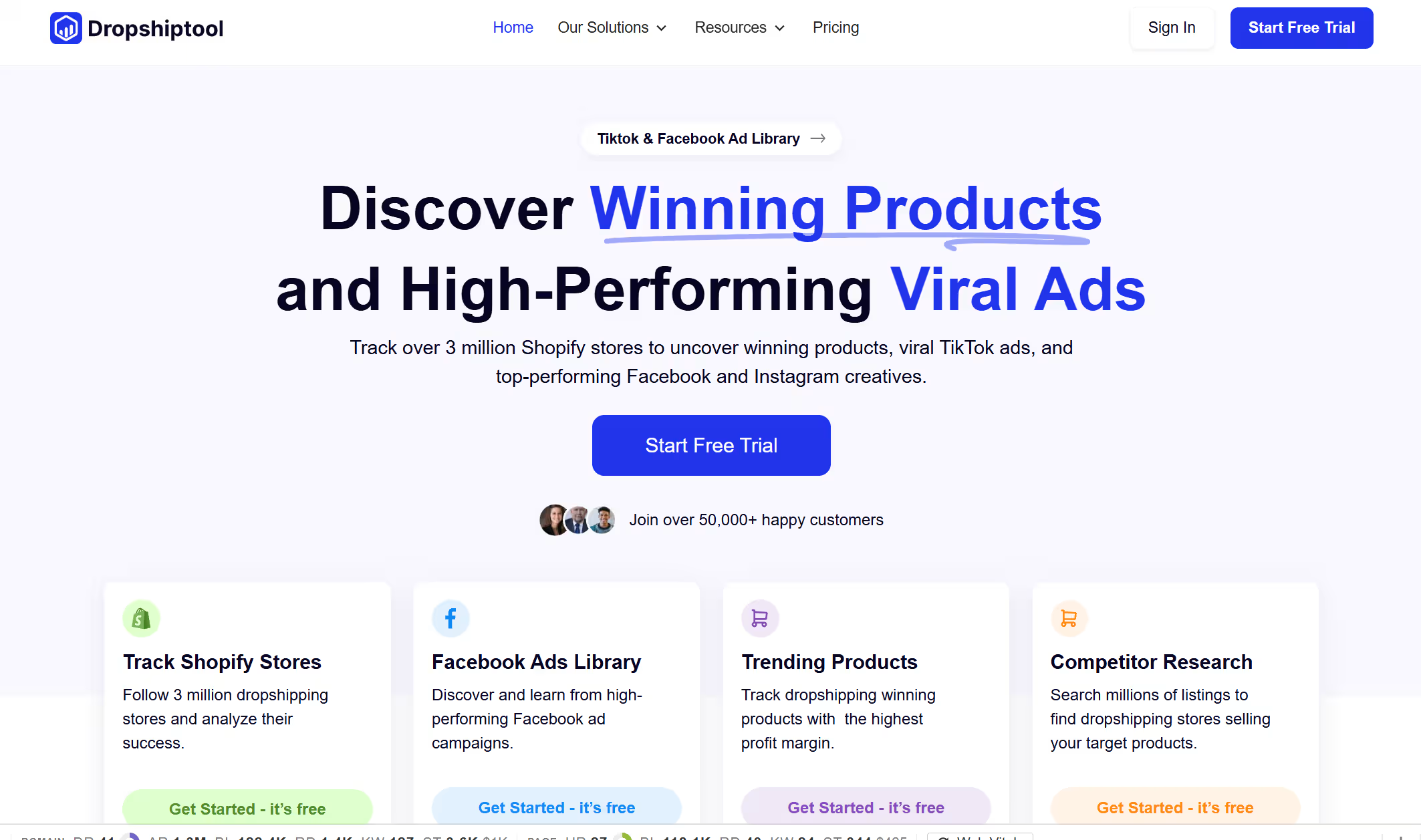
Instead of manually scrolling through marketplaces or relying on guesswork, Dropshiptool helps you identify trending Shopify products backed by real-time data and store performance insights.
Why It Stands Out
Dropshiptool gives you a competitive edge by helping you:
- Discover trending Shopify products before they peak
- Analyze what top-performing stores are selling
- Spot viral products with high demand potential
- Reduce trial-and-error when launching products
If your biggest challenge is finding products that actually sell, Dropshiptool makes the process faster, smarter, and far more data-driven.
4. AutoDS – Best for Full Store Automation
Automation is where AI delivers the biggest impact.
AutoDS helps manage your entire dropshipping workflow, including product imports, price monitoring, and order automation.
Key Features
- One-click product imports
- Automated price and stock updates
- Order fulfillment automation
- Performance tracking
If you want to reduce manual tasks and focus more on scaling your store, AutoDS is a strong choice.
5. Sell The Trend – Best for Product Research
Finding winning products is often the hardest part of dropshipping.
Sell The Trend uses AI to analyze trends, identify potential winning products, and track competitors.
Why It Matters
Instead of guessing, you get data-backed insights.
You can:
- Discover trending products early
- Analyze competitor performance
- Validate product demand
- Reduce risk when launching new items
This significantly improves your chances of success.
6. Tidio – Best for AI Customer Support
Customer support can quickly become overwhelming as your store grows.
Tidio uses AI chatbots to handle common customer queries like order tracking, refunds, and product questions.
Benefits
- 24/7 automated support
- Faster response times
- Reduced workload
- Improved customer satisfaction
This ensures your store remains responsive without needing a large support team.
7. Jasper – Best for Ad Copy and Campaigns
Marketing is essential in dropshipping, and writing good ad copy consistently can be difficult.
Jasper helps generate ad headlines, email sequences, and promotional content quickly.
Best Use Cases
- Facebook and Google ads
- Email campaigns
- Landing page copy
- Product positioning
It helps you test more ideas faster, which is crucial for scaling campaigns.
8. Canva AI – Best for Visual Content
Visuals play a huge role in conversions. Poor images can reduce trust and sales. Canva AI helps you create product visuals, banners, and social media creatives easily.
What You Can Do
- Design product images
- Create ad creatives
- Build social media content
- Improve brand visuals
This is especially useful if you don’t have a design team.
9. Prisync – Best for Pricing Optimization
Pricing can make or break your margins. Prisync uses AI to track competitors and adjust your pricing strategy accordingly.
Why It’s Useful
- Monitor competitor prices
- Optimize margins
- Stay competitive
- Adjust pricing dynamically
This helps you avoid underpricing or losing sales due to high prices.
Choosing the Right AI Tools Without Overcomplicating Your Stack
With so many AI dropshipping tools available, it’s easy to overdo it. The goal is not to use every tool—it’s to use the right ones.
Start with your biggest bottlenecks
Identify where you spend the most time:
- Product research
- Content creation
- Customer support
- Order management
Then choose tools that solve those specific problems.
Focus on integration and simplicity
Make sure your tools:
- Integrate well with Shopify
- Work together smoothly
- Don’t create unnecessary complexity
A simple system often performs better than a complicated one.
Building a Practical AI Stack for Shopify Dropshipping
If you’re starting out, keep your setup lean and effective. A practical stack might look like this:
- Product research tool for validation
- Content generator for descriptions
- Marketing tool for ads
- Automation tool for fulfillment
- Chatbot for customer support
As your business grows, you can expand your stack gradually.
The Future of AI in Shopify Dropshipping
AI is evolving rapidly, and its role in ecommerce will only grow. We are moving toward:
- Fully automated ecommerce workflows
- Personalized shopping experiences
- Predictive product recommendations
In the future, AI may handle entire customer journeys—from discovery to purchase.
This means the businesses that adopt AI early will have a significant advantage.
Common Mistakes to Avoid When Using AI in Dropshipping
AI can make your Shopify dropshipping business faster, leaner, and easier to manage. But that does not mean it can run your business on its own. Many store owners start using AI expecting instant results, only to realize that automation without direction can create just as many problems as it solves.
Before you rely too heavily on any tool, it helps to understand where things usually go wrong.
Over-reliance on automation
One of the biggest mistakes is assuming AI can make every decision for you. It can speed up research, generate content, and automate workflows, but it still lacks the judgment that comes from understanding your audience, brand, and market. If you let AI handle everything without reviewing the output, your store can start to feel generic and disconnected.
AI works best when it supports your strategy rather than replacing it. Use it to reduce repetitive work, not to remove your role from the business. You still need to review product choices, refine messaging, and make sure every decision aligns with your long-term goals.
Ignoring branding
AI can write product descriptions, generate ad copy, and even create email campaigns in seconds. But if you publish everything exactly as it comes out, your brand can quickly lose its personality. Customers do not connect with stores that sound robotic, repetitive, or indistinguishable from dozens of others in the same niche.
Your brand voice should still guide every piece of content. Even when AI gives you a solid draft, it is worth editing the language so it feels natural, consistent, and specific to your audience. That extra layer of human input is often what makes a store feel trustworthy and memorable.
Using too many tools
It is easy to get excited about new AI tools and start stacking them into every part of your workflow. But more tools do not always mean better results. In many cases, too many apps create confusion, overlapping features, extra costs, and messy systems that are harder to manage than the manual process you started with.
A better approach is to build your setup slowly. Start with the areas that consume the most time, such as product research, content creation, or order fulfillment. Once those are running smoothly, you can add other tools only if they solve a real problem and fit naturally into your workflow.
Skipping validation
AI can help you spot trends and suggest products, but it should never be the only reason you launch something. A product may look promising in a dashboard, yet still fail because of weak demand, poor margins, shipping issues, or a mismatch with your target audience. Relying only on AI recommendations can lead to costly decisions.
That is why validation still matters. Check supplier reliability, review competitors, test product-market fit, and make sure the numbers actually work for your store. AI can point you in the right direction, but strong business decisions still need real-world confirmation before you scale.
Conclusion
AI is changing the way Shopify dropshipping businesses operate, and for good reason. It helps you move faster, automate repetitive work, and make smarter decisions across product research, marketing, customer support, and fulfillment. When used well, it can turn a time-consuming store into a much more efficient business.
The real advantage, though, comes from combining automation with the right systems and suppliers. That is where Spocket can make a meaningful difference. If you want to build a Shopify dropshipping business that feels more automated without sacrificing quality, start with the right tools and the right foundation. Explore Spocket and see how it can help you create a store that is easier to manage, faster to scale, and built for long-term growth.
Start your dropshipping business today
FAQs About AI Tools for Shopify Dropshipping
What are the best AI tools for Shopify dropshipping?
The best AI tools for Shopify dropshipping depend on your needs. For product research, tools like Sell The Trend work well, while platforms like Smartli help with content creation. For automation and fulfillment, combining tools with Spocket ensures smoother operations and better supplier reliability.
Can AI fully automate a Shopify dropshipping business?
AI can automate a large part of your dropshipping workflow, including product research, content creation, marketing, and customer support. However, it cannot fully replace strategic decision-making, branding, and product validation, which still require human input.
How does AI help in product research for dropshipping?
AI tools analyze large amounts of data from marketplaces and social platforms to identify trending products. They help you spot demand patterns, validate product potential, and reduce the risk of choosing items that may not perform well.
Is using AI for Shopify dropshipping expensive?
Not necessarily. Many AI tools offer affordable plans or free versions, making them accessible even for beginners. You can start with a few essential tools and scale your stack as your business grows and generates revenue.
Which AI tool is best for automating order fulfillment?
Tools like AutoDS are commonly used for automation, but pairing automation with reliable supplier platforms like Spocket ensures faster shipping, better product quality, and a smoother customer experience overall.


Launch your dropshipping business now!
Start free trial


Related blogs

Minea Review: Is It Worth It for Dropshipping Product Research?
Read this Minea review to explore its features, pros, cons, pricing value, and whether it is the right product research tool for dropshipping sellers.


Top AI Tools for Small Businesses in 2026
Learn about the top AI tools for small businesses in 2026 for content, finance, agents, and automation. Pick the best AI tools for small businesses that match your workflows and budget, from free and paid.

Which are the Best Print on Demand AI Tools in 2026?
Find out which are the Print on demand AI tools in 2026. Save time, boost ROI, and improve product quality. Compare features, pricing, and real workflows for POD stores.
