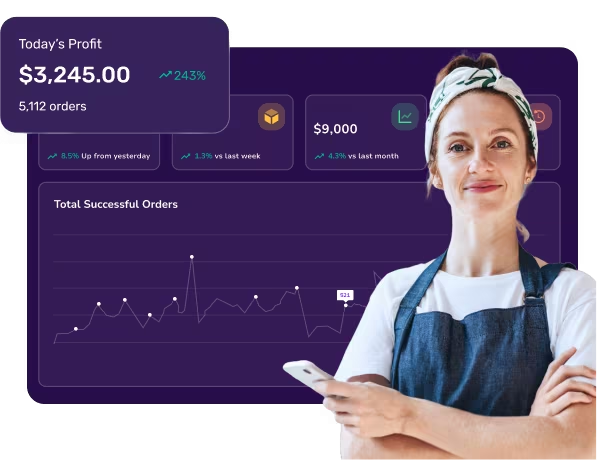
Best Predictive AI Tools for Inventory Forecasting in 2026
Learn about the best predictive AI tools for inventory forecasting. Find out which are the top predictive AI inventory forecasting solutions in 2026.

You are losing money right now, and you don't even know it. Tied-up cash in dead stock or lost sales from empty shelves is silently killing your business. But you can stop the guessing game.
Predictive AI tools for inventory forecasting use smart tech to look at your sales history and tell you exactly what to buy, when to buy it, and how much to stash away. Stop drowning in spreadsheets. If you want to protect your cash flow and keep your customers happy, you need to start using these tools in 2026.
What is Inventory Forecasting?
Inventory forecasting is how you figure out how much product you will sell in the future. You look at past sales, seasonal trends, and current market vibes to decide what to order from your suppliers. If you get it wrong, you end up with too much junk in your warehouse or angry customers who can't buy your best stuff. Predictive AI tools for inventory forecasting do all this math for you automatically. They spot hidden patterns in your data that you would never see, so you can stop guessing and start knowing exactly what your business needs to run smoothly.
Types of Predictive AI Tool for Inventory Forecasting
Not every AI tool works the same way. You will find different types of predictive AI tools designed to fix specific inventory headaches. Knowing the difference helps you pick the right fit for your business setup.
Demand Forecasting Platforms
These tools focus purely on future customer demand. You feed in years of sales data, and the AI predicts how many units you will sell next week or next month. They use AI algorithms for analysing everything from seasonality to random market shifts. If you run an ecommerce store, you need this type to avoid stockouts during your busy season. They give you granular forecasts so you know exactly what to reorder.
Automated Replenishment Systems
These tools do the ordering for you. Once the AI predicts you are running low, it sends a purchase order to your supplier automatically. You do not have to lift a finger. This works great for businesses with hundreds of SKUs where manual ordering is a nightmare. These systems consider supplier lead times and shipping delays so your stock arrives right before you run out, not two weeks later.
Where and How to Find Predictive AI Tools for Inventory Forecasting
You can find these tools directly on software marketplaces like the Shopify App Store or through independent AI software directories. Many enterprise tools also list directly on their own websites with free trials available for 2026.
- You can find free predictive AI tools for inventory forecasting on open-source platforms like GitHub. Search for "AI inventory management GitHub" to find community-built models you can customize. Just remember that free tools might need more technical setup on your end.
- Premium AI tools for inventory forecasting are usually listed on G2 or Capterra with real user reviews from 2026. You can filter by industry, business size, and pricing to see what fits your budget. Most paid AI tools for inventory forecasting offer a 14-day free trial so you can test before buying.
- Top 10 inventory forecasting tools for 2026 lists often come from software review blogs like GMDH or SoftwareWorld. These roundups compare features side-by-side so you do not have to click through ten different websites. You will find both free and paid options ranked by actual user ratings.
- Shopify merchants should check the Shopify App Store specifically. Many predictive AI tools for inventory forecasting are built as native Shopify apps that sync with your store instantly. You can install them in one click without hiring a developer. Check out out dropshipping inventory management guide as well.
- Enterprise businesses can request demos directly from vendors. These companies offer personalized walkthroughs where they show you exactly how their AI handles your specific supply chain problems. You will get a custom quote based on your order volume and number of SKUs. They will also offer you the best apps for inventory optimization.
- YouTube and industry webinars are great for seeing these tools in action before you commit. Watch a live demo to see how the AI dashboard looks and whether your team can figure it out easily. Most AI vendors post 2026 tutorial videos showing their latest features.
Benefits of Inventory Forecasting with Predictive AI Tools
When you bring AI into your inventory workflow, you stop reacting to problems and start preventing them. Here is what you gain by switching to smart forecasting in 2026.
- You slash your holding costs because you stop buying stock that just sits there. Predictive AI tools for inventory forecasting tell you exactly what you need, so you do not waste cash on products that gather dust. Your warehouse space becomes profitable instead of expensive.
- Stockouts become a rare headache instead of a weekly crisis. AI inventory forecasting can prevent stockouts by seeing a dip coming and alerting you before you hit zero. You will never tell a customer "sorry, sold out" again if you set up these alerts correctly.
- Your supplier relationships get smoother when you place accurate orders on predictable schedules. AI considers lead time variability so you order early enough to cover shipping delays. No more rush shipping fees because you miscalculated. If you are looking for the best US and EU suppliers for dropshipping, check out Spocket.
- Cash flow becomes easier to manage because you are not guessing how much money to set aside for inventory. The AI forecasts your purchasing needs weeks in advance so you can plan your spending. Your accountant will thank you for the predictable numbers.
- You save hours every week that you used to spend staring at Excel rows. The system can generate automated inventory reports with one click and handle what AI inventory management for restaurants and retailers need daily. You can focus on growing your business instead of babysitting your stock levels.
- New product launches get less scary because AI can benchmark against similar items in your catalog. The system analyzes sales patterns of your existing products to predict demand for new ones. You will order with confidence instead of guessing and hoping.
8 Best Predictive AI Tools for Inventory Forecasting
Here is a list of the 8 best predictive AI tools for inventory forecasting. These are our top picks for 2026:
1. Streamline
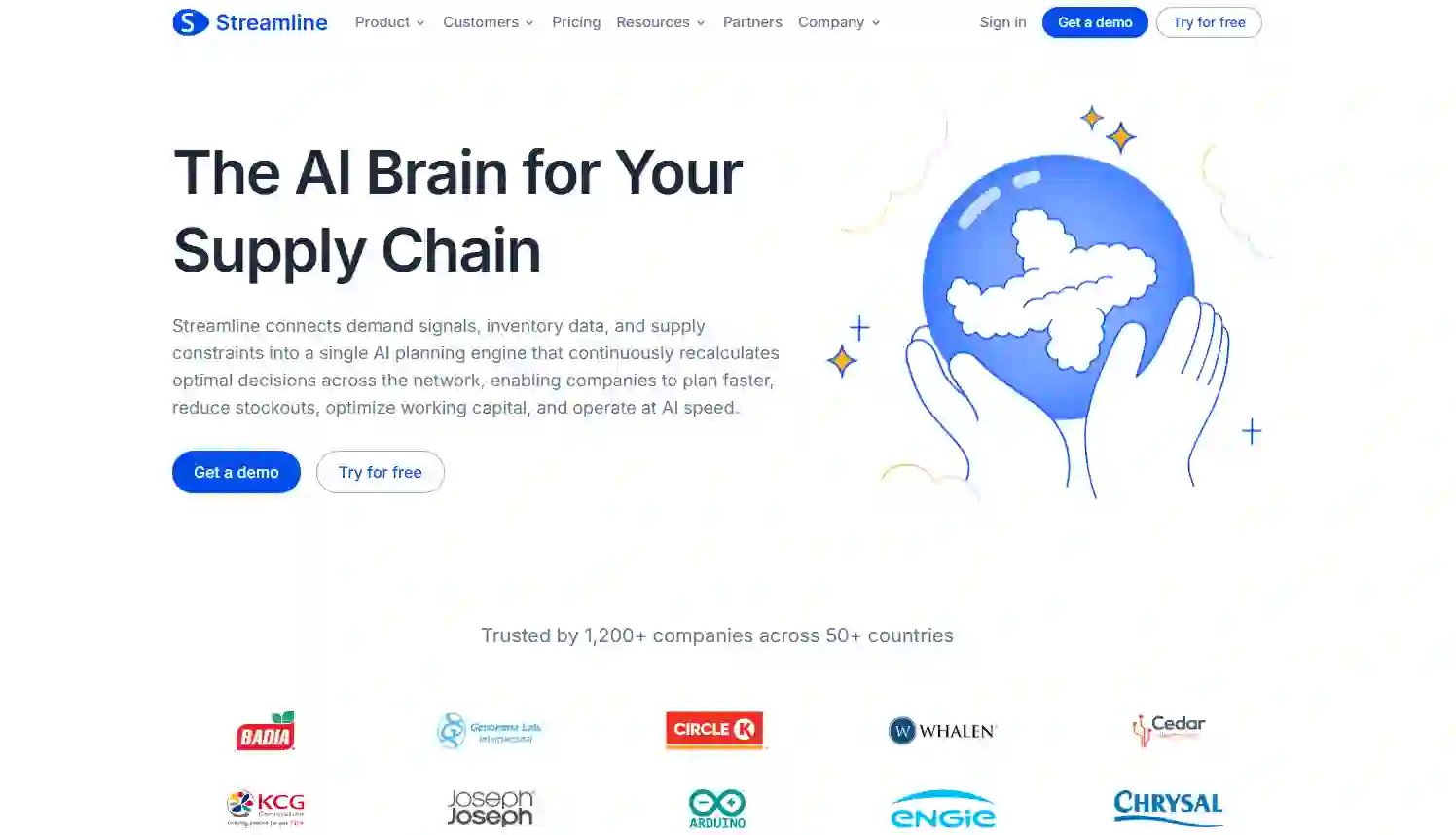
Streamline is the AI brain for your supply chain. You will see Streamline mentioned everywhere when you research best predictive AI tools for inventory forecasting, and for good reason. This enterprise-grade platform handles multi-echelon planning across your entire supply chain, not just one warehouse. Streamline uses discrete-event simulation to model real-world inventory flows with one-day precision, something Excel simply cannot do. Thousands of enterprise customers rely on its AI-powered platform to accurately forecast demand and optimize stock levels across manufacturers, retailers, and distributors. If you are tired of static spreadsheets that break every time your business grows, Streamline fixes that permanently.
Key Features
- It gives you up to 99%+ inventory availability while reducing out-of-stocks by up to 98%, numbers you cannot argue with.
- The platform syncs ordering dates across SKUs from the same supplier so you purchase full containers intelligently instead of paying for partials.
- You get AI-driven S&OP and S&OE (Sales & Operations Execution) that connect your long-term plans with daily actions.
- Implementation happens fast with multiple ERP integrations already built and tested for 2026 systems.
- Planning time optimizes by up to 90% because you stop manually adjusting formulas and let the AI run the numbers.
2. Pecan AI
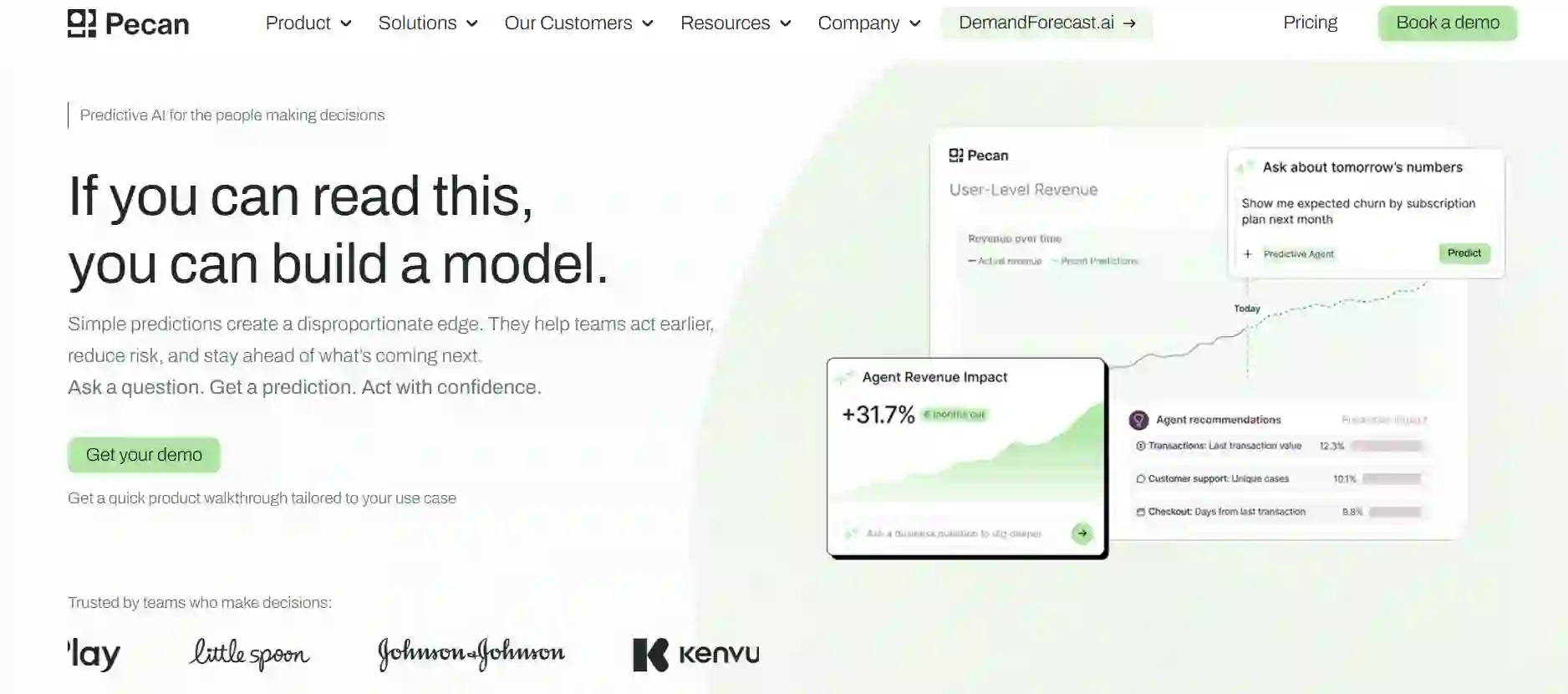
Pecan is predictive analytics software for humans. Pecan AI launched the world's first Predictive AI Agent in January 2026, and it changes how normal business teams interact with forecasting. You do not need data scientists or coding skills. You just plug in your raw data, ask plain-language questions like "how much of this product will sell next month?" and the agent delivers statistically validated predictions in minutes. The system interprets your unique company's data structure automatically, so you do not waste weeks cleaning up messy spreadsheets. For inventory forecasting, Pecan AI helps you predict demand shifts before they happen and coordinate resources efficiently across your supply chain.
Key Features
- The Predictive AI Agent handles the full workflow from translating business intent to preparing data, validating models, and delivering actionable predictions.
- You can ask questions in plain English without learning SQL or hiring a data team to build models for you.
- The platform includes statistical safeguards designed to reduce risks like data leakage and overfitting, so you can trust the numbers.
- Production-grade predictions become accessible to every team that makes decisions, not just locked away in a data science department.
- Pecan AI integrates with your existing databases and warehouses without forcing you to restructure your current tech stack.
3. Prediko
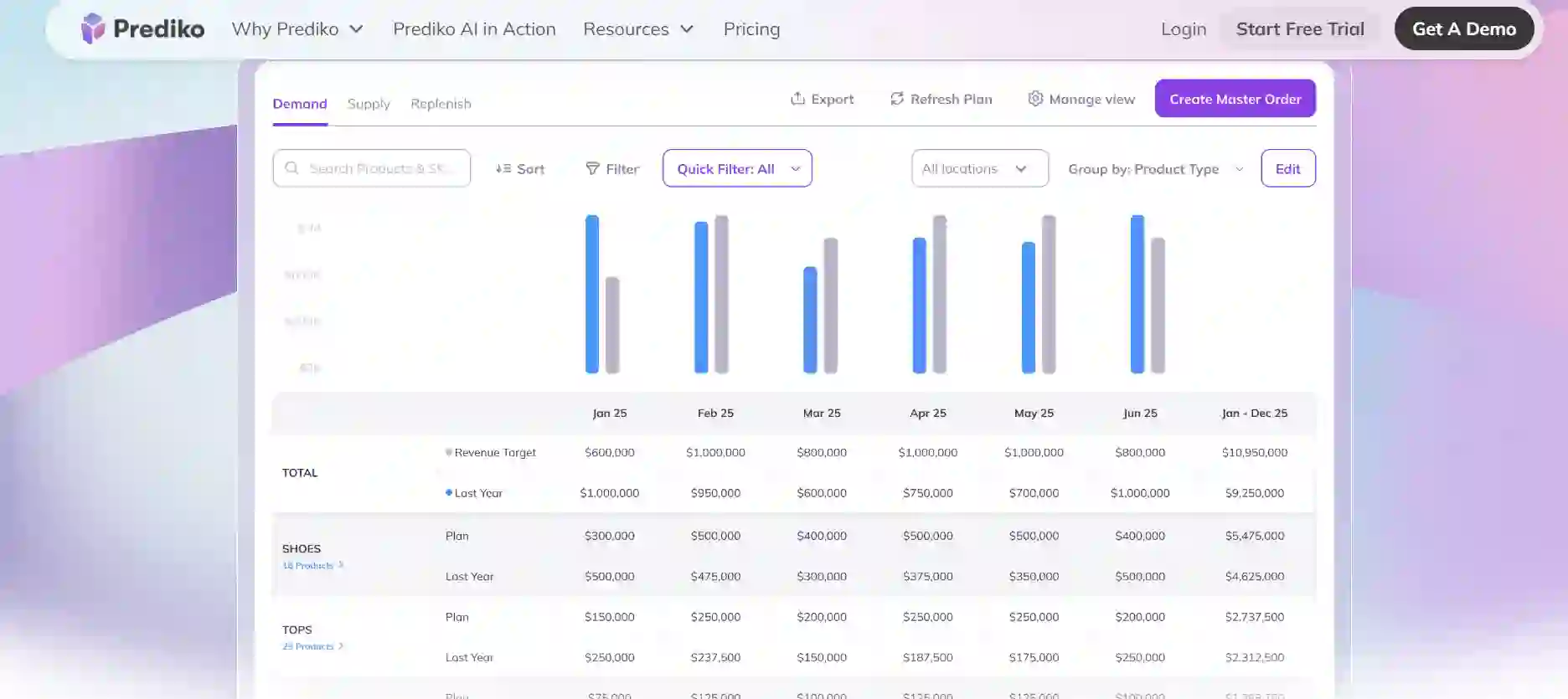
Prediko app is built specifically for Shopify brands that are tired of inventory chaos during growth spurts. The platform's AI forecasting algorithm is trained on over 25 million SKUs across 15 different industries, so it has seen patterns you probably have not. Prediko helps you predict demand with accuracy up to 95% and automates supply planning so you know exactly what, when, and how much to buy from your suppliers. Fast-growing D2C brands use Prediko to launch new products without fear because the AI benchmarks against similar items in their catalog. If you manage raw materials for in-house production, Prediko tracks those too and aligns them with your finished goods forecasts.
Key Features
- The AI factors in multiple sales channels simultaneously so you get one unified forecast across your website, Amazon, and retail stores.
- You receive low stock alerts tied directly to your forecast thresholds, so you know exactly when to reorder before you hit zero.
- The visual dashboard shows sales trends over time so you can easily spot seasonal patterns and adjust your buying accordingly.
- You can download detailed forecast reports and demand plans to share with your suppliers or finance team for better alignment.
- The platform offers raw materials management so brands with in-house production can track components alongside finished goods.
4. Anaplan
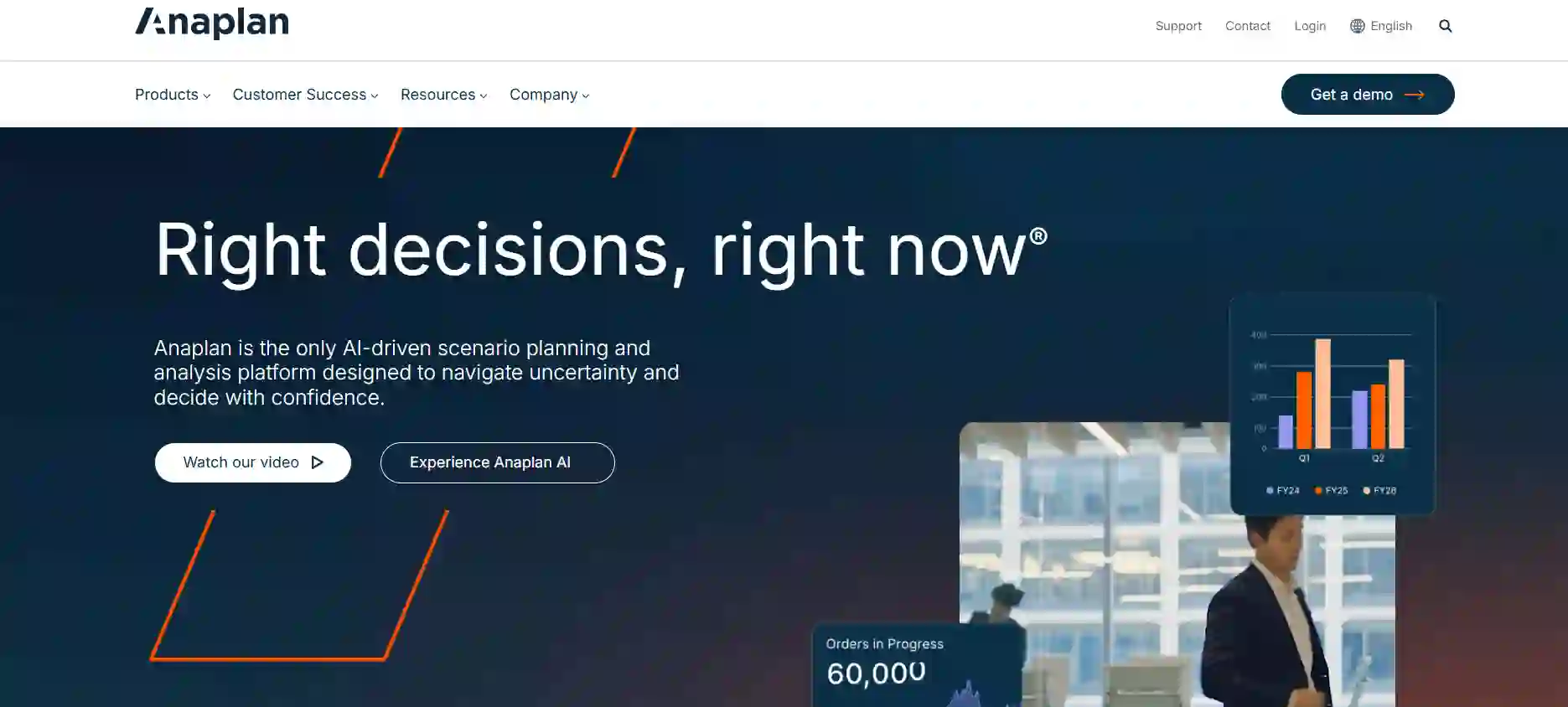
Anaplan launched a new suite of AI tools and 12 business planning applications in March 2026, expanding their predictive, generative, and agentic AI capabilities for enterprise planning. The platform's Forecaster tool uses machine learning-based time series forecasting to help large organizations predict demand across complex supply chains. Anaplan focuses heavily on AI-driven scenario planning and analysis, which means you can model different business outcomes based on changing market conditions. Retail leaders use Anaplan to get AI-ready by assessing their data quality before introducing AI into merchandise planning workflows. If you are a large retailer looking to sell more while carrying less stock, Anaplan's 2026 features are worth your time.
Key Features
- The new AI agents help you create and optimize planning models directly within your existing business workflows without learning new software.
- You can run unlimited scenario models to see how different demand patterns would affect your inventory levels and cash flow.
- The platform integrates predictive, generative, and agentic AI into one unified system so you get multiple types of intelligence in one place.
- Anaplan connects financial planning with supply chain planning so your budget and your inventory numbers actually match.
- The Forecaster tool offers transparent, explainable algorithms so you understand why the AI made certain predictions, not just what it predicted.
5. Logility
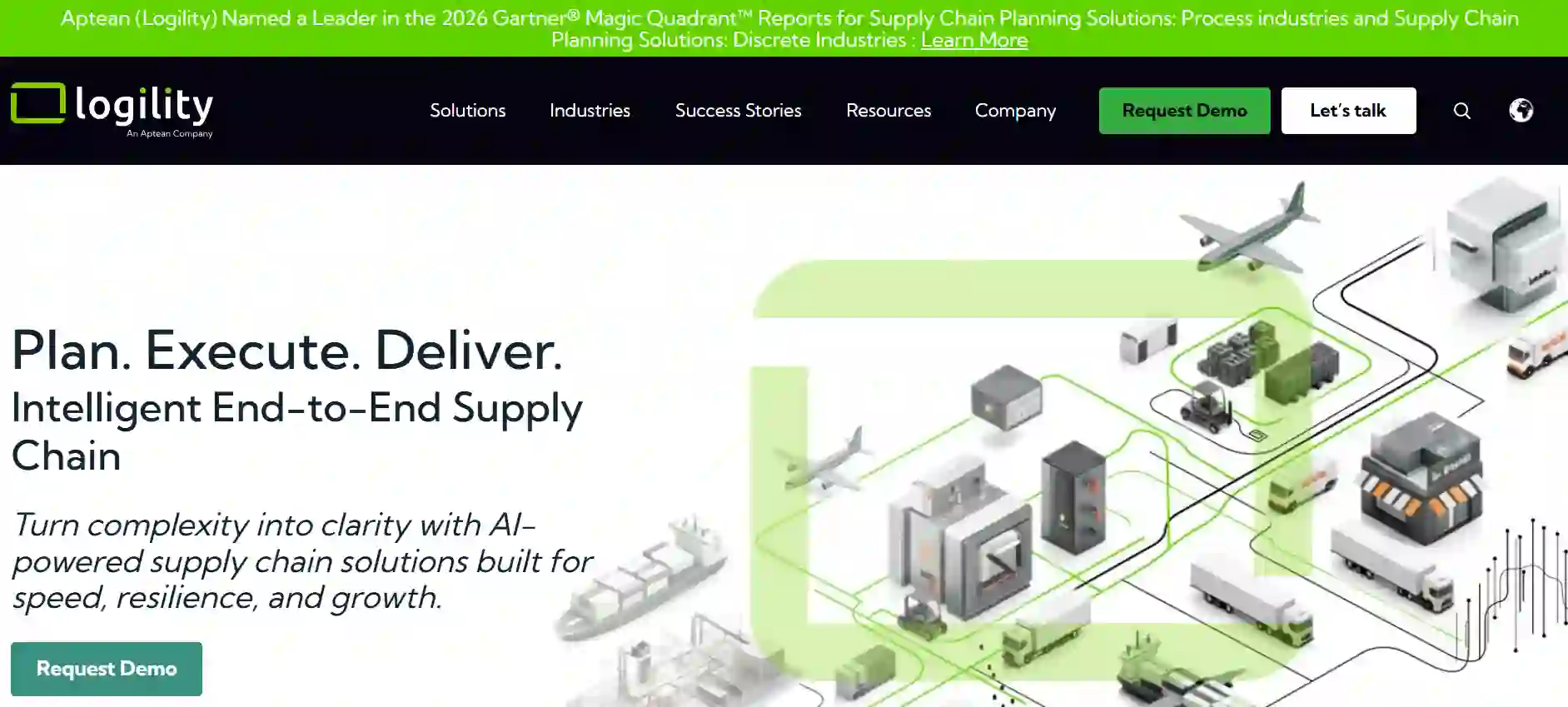
Logility made a smart move in 2026 by acquiring Garvis AI and integrating their DemandAI+ technology into the platform. DemandAI+ combines generative AI with traditional machine learning to revolutionize how you forecast demand and optimize inventory. Logility has been in the supply chain game for over 45 years, but this new AI injection makes them feel fresh and modern again. The platform helps you plan more accurately and flexibly by combining forecasting, merchandise planning, and assortment planning into one workflow. With a 94% customer recommendation rate, Logility clearly does something right for businesses that need serious supply chain intelligence.
Key Features
- The DemandAI+ technology integrates generative AI with machine learning algorithms to enable real-time demand planning at market speed.
- You can optimize inventory across multi-echelon supply chains, meaning you manage stock at every level from raw materials to finished goods.
- The platform offers production planning and scheduling alongside demand forecasting so your operations stay aligned with sales projections.
- Logility's AI helps you manage transportation and supply chain collaboration, so your forecasts connect to actual shipping logistics.
- The 2026 acquisition of Garvis means you get generative AI features that traditional forecasting tools simply do not offer yet.
6. RELEX Solutions
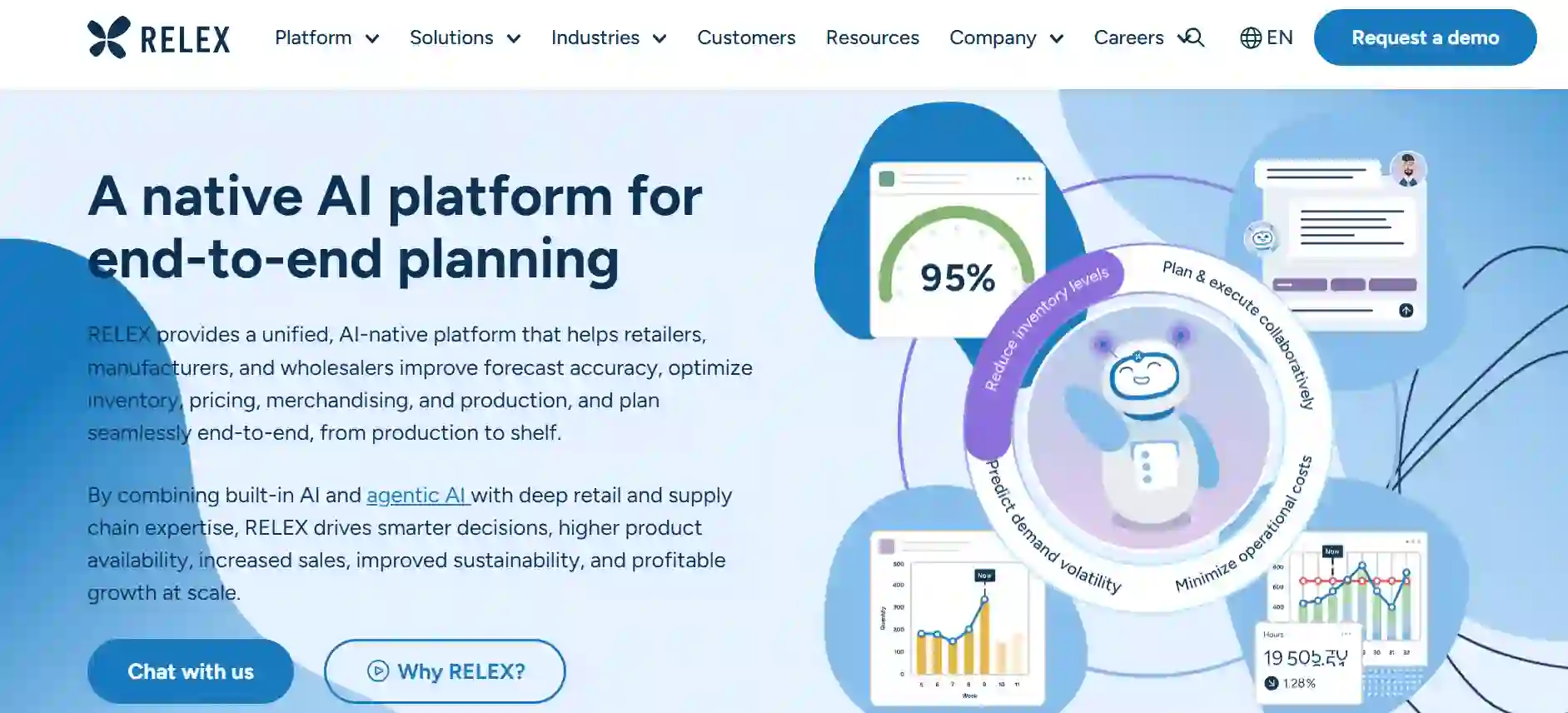
RELEX showed up big at NRF 2026 with advancements in AI-driven retail planning that help retailers increase availability, protect margins, and reduce waste. The platform unifies forecasting, inventory optimization, pricing, and promotions into one connected system, so you are not juggling separate tools. In March 2026, food wholesaler METRO tapped RELEX to enhance forecasting across 540 stores and 70 distribution centres as part of their Ultra Fresh initiative. RELEX also helps you with Advanced Diagnostics that use AI to identify spoilage, stockout, and inventory issues before they become expensive problems. For retailers with perishable goods or complex supply chains, RELEX brings serious AI firepower.
Key Features
- You get AI-assisted spoilage and stockout analysis that helps planners identify waste drivers and make faster, more informed decisions.
- The platform integrates with vendor-managed inventory (VMI) and assortment planning capabilities so suppliers help manage your stock levels.
- RELEX helps you predict demand spikes with greater accuracy and align store replenishment with distribution centre planning.
- The unified platform connects forecasting, inventory, pricing, and promotions so you see the full picture instead of disconnected pieces.
- You can use Advanced Diagnostics to understand the root causes behind waste and availability problems, not just the symptoms.
7. Cin7 (Foresight AI)
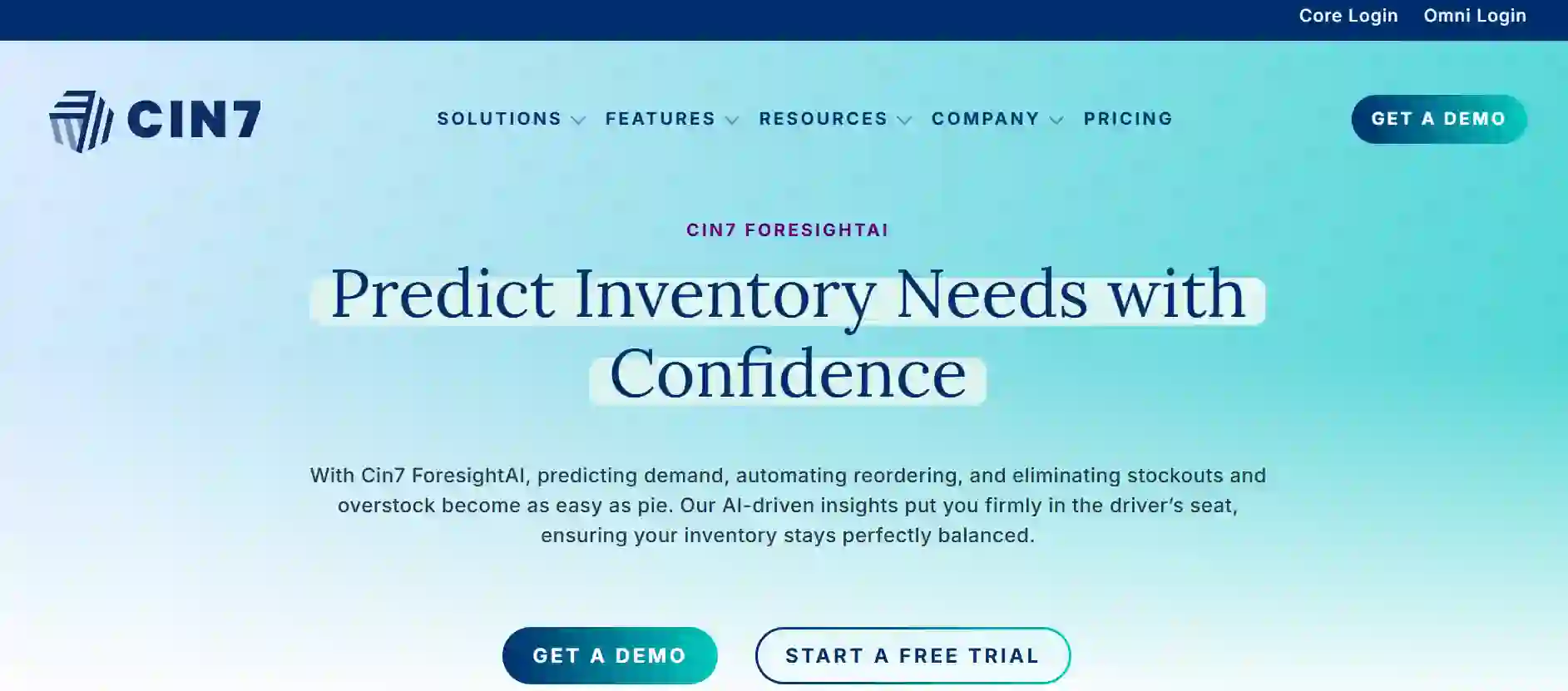
Cin7's Foresight AI takes up to two years of your sales history and runs it through around 100 different inventory forecasting algorithms to produce highly credible demand predictions. The system then averages the outputs from all those algorithms to give you a balanced forecast you can actually trust. In 2026, Cin7 announced a strategic partnership with Rillet to bring AI-native accounting to product businesses, combining Foresight AI's demand forecasting with financial automation. You can get automated inventory reconciliation, SKU-level profitability analysis, and anomaly detection all in one platform. Cin7 works best for high-volume retailers and wholesalers selling across multiple channels who need 24-month prediction capabilities with automated replenishment suggestions.
Key Features
- Foresight AI gives you 24-month prediction capabilities with automated replenishment suggestions tied directly to your forecasts.
- The platform connects to 700+ prebuilt integrations including Shopify, Amazon, Xero, and QuickBooks so your data flows automatically.
- You get SKU-level profitability analysis that shows you exactly which products are worth stocking and which are draining your cash.
- The AI predicts demand patterns to help you avoid overstock and stockouts by identifying key products and optimizing order sizes.
- The new partnership with Rillet adds automated inventory valuation reconciliation and COGS accuracy to your forecasting workflow.
8. Zoho Inventory
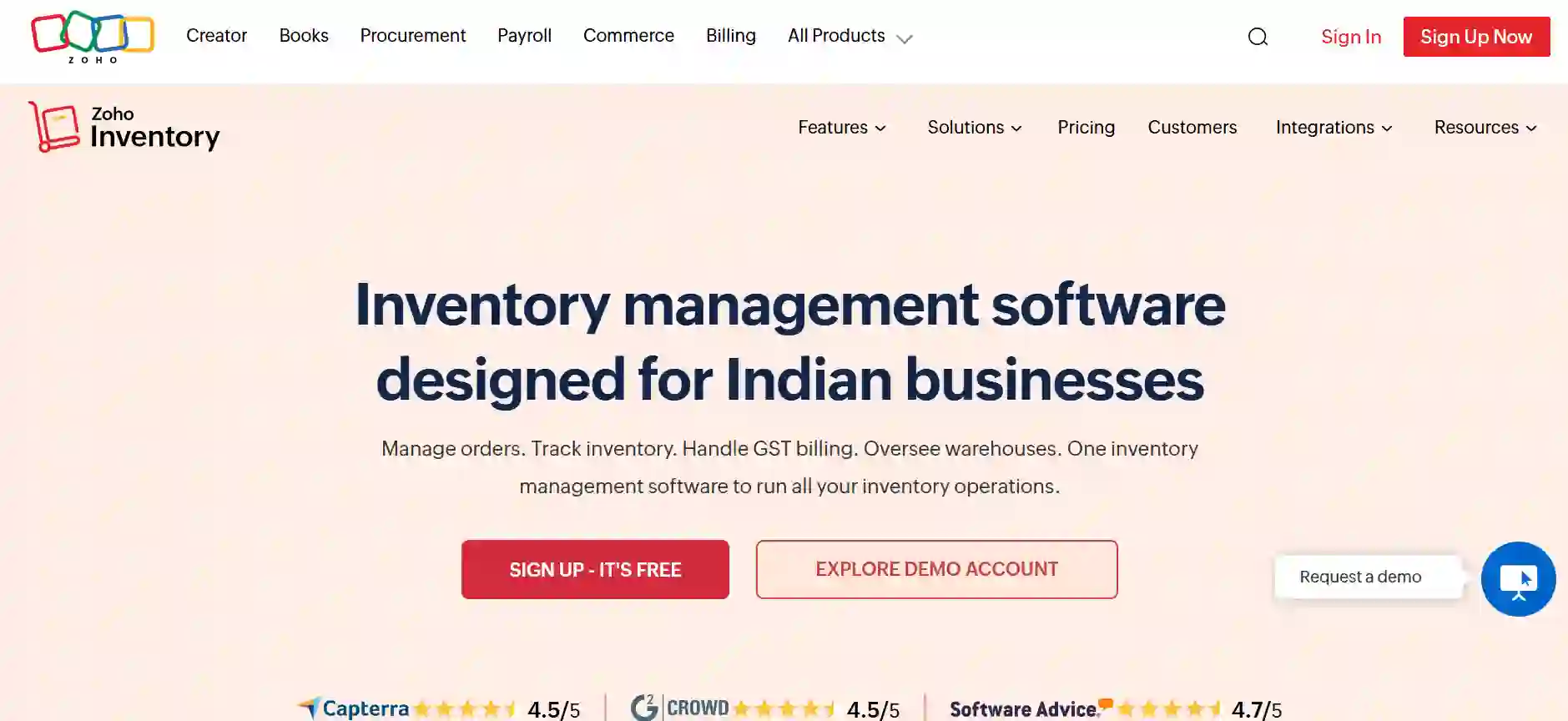
Zoho Inventory comes with Zia, their built-in AI assistant who handles smart forecasting directly inside your dashboard. You will find Zia's recommendations on your item detail page, where she gives you predictions on future sales and alerts you when to reorder. For 2026, Zoho doubled down on AI-driven ERP features, using Zia to automate forecasting, anomaly detection, and reporting across your inventory operations. You can also layer Zoho Analytics on top of your inventory data to get deeper insights into slow-moving stock, demand trends, and replenishment planning. Zoho Inventory works perfectly for small to medium businesses that already use their ecosystem and want affordable AI without enterprise price tags.
Key Features
- Zia analyzes historical sales data alongside external factors like weather patterns, competitor pricing, and social media trends to uncover hidden demand signals.
- You get automated anomaly detection that flags unusual inventory patterns before they become real problems.
- Zoho Analytics helps you identify slow-moving stock and analyze demand trends so you can improve your replenishment planning.
- The AI adjusts availability and replenishment decisions while forecasts are still playing out, so you react before stock runs out.
- Zia gives you sales predictions directly on each product's detail page, so you do not have to dig through reports to find answers.
Conclusion
You do not need to be a tech wizard to fix your inventory problems in 2026. Predictive AI tools for inventory forecasting put smart demand planning into your hands without requiring a data science degree. Whether you run a small Shopify store or a massive retail operation, there is an AI tool built for your size and budget. Stop guessing how much to order and start using real predictions based on your actual sales data.
Your cash flow will improve, your customers will stay happy, and you will finally sleep better knowing your stock levels are under control. Start using Spocket and enjoy automated inventory sync for your dropshipping products today!
Start your dropshipping business today
Best Predictive AI Tools for Inventory Forecasting
What are predictive AI tools for inventory forecasting and how do they work?
Predictive AI tools for inventory forecasting use machine learning algorithms to analyze your historical sales data, seasonal patterns, and market trends. They spot hidden correlations in your numbers and generate accurate demand predictions. You can use these forecasts to decide exactly how much stock to order, when to order it, and which products need your attention most.
Can small businesses afford predictive AI tools for inventory forecasting?
Yes, you can find affordable options starting as low as $19 to $49 per month. Many free predictive AI tools for inventory forecasting also exist on platforms like GitHub if you do not mind a bit of technical setup. Small businesses typically start with Shopify apps like Prediko or Zoho Inventory before moving up to enterprise solutions as they grow.
How accurate are predictive AI tools for inventory forecasting compared to manual methods?
Top AI tools claim accuracy rates of 95% or higher, which is far better than manual Excel guessing. Manual forecasting usually misses subtle seasonal shifts and random demand spikes that AI catches automatically. You will see fewer stockouts and less overstock within your first month of using a proper AI tool.
Do predictive AI tools for inventory forecasting work for businesses with multiple sales channels?
Yes, most modern AI tools are built specifically for multi-channel sellers. You can connect your website, Amazon, Shopify, retail stores, and wholesale accounts all into one forecast. The AI combines data from every channel to give you a complete picture of your total inventory needs across your entire business.


Launch your dropshipping business now!
Start free trial.avif)


Related blogs
Dropshipping Supplier Directory: Where to Find Vetted Suppliers
Browse our directory of vetted dropshipping suppliers across the US and EU, complete with niches, shipping speed, and pricing. Start your free trial today.

How to Negotiate With Dropshipping Suppliers: 9 Tactics That Actually Work
Learn how to negotiate with dropshipping suppliers on price, MOQs, and payment terms. Proven tactics and email scripts to boost your margins. Try Spocket free.

Best Clothing Dropshipping Suppliers: The 2026 Guide
Compare the best clothing dropshipping suppliers for 2026 — US/EU shipping speeds, pricing, and product quality — and find the right fit to launch your store.