Is Data Annotation Legit
Is data annotation legit? Learn what data annotation work is, how platforms pay, red flags to avoid scams, and a safe checklist before you apply.

.avif)

If you’ve been searching for remote work lately, you’ve probably seen “data annotation” pop up everywhere. The pitch is usually the same: flexible hours, work from home, and decent pay for tasks like labeling images, rating AI answers, or rewriting prompts. It sounds simple, but it also sounds like the kind of thing scammers love to copy.
So, is data annotation legit?
Yes, data annotation as a type of work is real. It’s a core part of building AI systems, and companies spend a lot of money on it. At the same time, the job market around data annotation is messy: not all platforms are transparent, work can be inconsistent, onboarding can be confusing, and scam job posts do exist.
This article explains what data annotation work actually is, why legit companies hire for it, how to evaluate platforms safely, what to expect about pay and availability, and how to protect yourself from “data annotation scams” that have nothing to do with real AI work.
What data annotation really means
Data annotation is the process of labeling or structuring data so machine learning models can learn patterns. The simplest way to understand it is this:
- AI models don’t “understand” raw data automatically.
- Humans help by tagging what the data represents.
- The model learns from those labels to make better predictions later.
Depending on the project, annotation can be extremely basic or surprisingly complex.
Common types of data annotation tasks
Text annotation
- Classifying text (spam vs not spam, positive vs negative sentiment)
- Highlighting entities (names, addresses, product attributes)
- Evaluating AI responses (helpful, harmful, accurate, misleading)
- Writing or rewriting responses to improve quality
Image annotation
- Drawing bounding boxes around objects (cars, faces, products)
- Tagging image categories (shoe vs sandal vs boot)
- Marking defects (scratches, missing parts, wrong color)
Audio annotation
- Transcribing speech
- Labeling speakers
- Marking background noise or key moments
Video annotation
- Tracking movement frames
- Identifying events (a person picks up an object, a car stops)
- Segmenting scenes
This work exists because AI depends on training data.
Why companies pay for data annotation
Data annotation is not charity work and it’s not “busy work.” Companies pay for it because:
Models need high-quality training signals
If the labels are wrong, the model learns the wrong thing. That’s why many companies value:
- accuracy over speed
- consistent labeling
- careful reading and structured thinking
Some tasks require cultural or domain knowledge
Some companies prefer certain worker pools when tasks depend on cultural context or specialized skills, and pay can vary widely.
AI is expanding into more industries
Customer support tools, search ranking models, recommendation systems, fraud detection, medical and legal copilots—all of them rely on evaluation and training data.
So yes, the category is legitimate. The more important question is usually:
Which platforms are legitimate, and what should you expect?
Is data annotation legit as a job
Yes, data annotation is a legitimate job and an essential part of how modern AI systems are built and improved. Companies rely on human reviewers to label data, evaluate AI outputs, and correct mistakes so machine learning models can learn accurately. That said, data annotation is usually project-based and treated as contract work rather than a traditional full-time role. While many people earn real money doing it, work availability can fluctuate, so it’s best viewed as flexible or supplemental income rather than a guaranteed long-term job.
The legitimate part
Data annotation is a real line of work. People do get paid to do it, and there are real companies allocating real budgets to it.
The tricky part
Even when a platform is real, you may still experience:
- inconsistent task availability
- unpaid or low-paid qualification tests
- unclear acceptance criteria
- sudden project pauses
- limited support response
This is why many experienced workers treat it as supplemental income, not a guaranteed full-time paycheck.
The biggest confusion People mix up two different things
When someone asks “is data annotation legit,” they usually mean one of these:
1) Is data annotation a real job category
Yes. It’s a genuine part of AI development.
2) Is this specific platform or offer legit
That depends. Some are legitimate; some are predatory; some are outright scams pretending to be data annotation work.
This article helps you evaluate #2 safely.
The safest way to tell if a data annotation opportunity is legit
Use this checklist before you sign up, share documents, or do any tests.
The legitimacy checklist
Before signing up for any data annotation platform, it’s important to verify that the opportunity is real and not a disguised scam. A legitimate platform will never ask you to pay to apply, won’t pressure you to act immediately, and will clearly explain how tasks, payments, and eligibility work. It should also have consistent third-party feedback and a professional onboarding process inside a secure dashboard, not through random messaging apps. Using a simple legitimacy checklist helps you protect your identity, avoid fake job offers, and choose platforms that offer real annotation work with transparent payouts.
1) Legit platforms never ask you to pay to apply
If you see:
- “registration fee”
- “training fee”
- “software fee”
- “ID verification fee”
- “deposit to unlock tasks”
Walk away.
A common pattern in job scams is charging victims money “to get started.” Real work platforms do not need your money to hire you.
2) Legit platforms don’t require you to buy equipment through them
Employment scams often push fake laptops, “work kits,” or reimbursement schemes. Real annotation platforms typically operate through a web dashboard.
3) Legit platforms are specific about the work, not just the money
Scam posts are usually vague:
- “Earn $300/day easily”
- “No skills required, immediate payout”
- “Limited spots, apply now”
Legit platforms describe:
- task types
- qualification steps
- pay structure (hourly vs per task)
- payment methods
- eligibility requirements
4) Legitimacy shows up in consistent third-party feedback
Look for:
- reviews on multiple sites (not only testimonials on the platform)
- specific descriptions of payment, payout methods, and task flow
- a consistent pattern over months (not a burst of identical reviews)
5) Be realistic about “too good to be true” promises
Even legit platforms can advertise high rates for specialized tasks. TIME mentions examples of higher-paying tasks in the market (often for specialized expertise).
But if a random ad promises extreme pay with zero screening, that’s a red flag.
Is DataAnnotation.tech legit
This is one of the most searched platforms in this space, so it’s worth addressing carefully and fairly.
What the platform claims
DataAnnotation.tech positions itself as a place to do remote AI training tasks, with pay “starting at $20+/hour,” and higher pay for expert projects.
On Trustpilot, DataAnnotation currently shows an “Excellent” TrustScore of 4.3/5, based on ~1,905 reviews. This volume of feedback is a strong signal that many real users have interacted with the platform over time. At the same time, the reviews are mixed—alongside positive comments about pay and flexibility, some users mention inconsistent task availability and communication gaps, which is why it’s best treated as flexible gig work rather than guaranteed income.
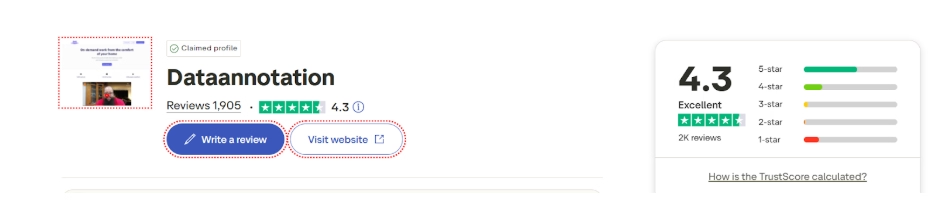
Bottom line: there’s strong evidence that real people have done real tasks and received payouts, but it’s still not a guaranteed or stable income stream for everyone.
What to expect if you do data annotation work
This is the practical part most people wish they knew earlier.
You will likely need to pass qualification steps
Many platforms require:
- an initial assessment
- “calibration” tasks
- guidelines quizzes
- sample labeling work
Sometimes those steps are paid, sometimes not, and sometimes results aren’t explained clearly.
Work availability can be inconsistent
Even when a platform is legitimate, task volume depends on:
- client demand
- project cycles
- your quality scores
- your geography and eligibility
- what you’re qualified for
Pay can vary a lot
Pay may depend on:
- task difficulty
- how specialized you are (coding, math, domain expertise)
- speed + accuracy (some platforms emphasize accuracy)
- region and language
Expect contractor-style work, not employment protections
Most platforms treat contributors as independent contractors. That usually means:
- no guaranteed hours
- no paid leave
- you handle your own taxes
- work can pause without notice
Common scam patterns using the words “data annotation”
Even if the platform name looks legit, scammers can impersonate it. Watch for these specific tricks:
Fake recruiter outreach on WhatsApp or Telegram
A scammer pretends to be a recruiter and offers instant hiring. They push you into:
- paying a fee
- sharing sensitive IDs
- clicking suspicious links
“Deposit to unlock tasks”
You are asked to pay a small amount that “proves you’re serious.” Then it escalates.
Crypto or investment “data annotation”
Some scams mix “data annotation” with:
- crypto deposits
- investment returns
- “earning by completing tasks” on a fake app
That’s not annotation work. That’s a financial scam.
Fake checks and reimbursement fraud
The scammer sends “funds” for you to buy equipment. The funds bounce, and you lose money.
If any money flow feels complicated, step back. Legit platforms typically pay you—full stop.
How to evaluate any data annotation platform safely
If you’re considering a platform (whether it’s DataAnnotation.tech or something else), do these checks:
Check the official domain carefully
Scammers often use near-identical domains (extra hyphens, misspellings, subdomains).
For DataAnnotation.tech, make sure you are on:
- dataannotation.tech
- not a lookalike
Confirm it has real public presence and long-term feedback
A single blog post is not proof. Look for:
- third-party reviews (like Trustpilot)
- media coverage (like TIME’s reporting)
Watch what happens after you sign up
A legitimate process usually looks like:
- dashboard access
- clear rules and guidelines
- structured qualification tasks
- clear payout mechanism
A scam process usually looks like:
- immediate “Congratulations you’re hired”
- pressure to act fast
- fees and deposits
- moving you off-platform into chat apps
How much can you realistically earn
Here’s the realistic framing:
Treat it like a flexible gig with variable income
Many people earn meaningful side income when:
- they qualify for multiple projects
- they maintain strong quality
- they work consistently when tasks are available
But because availability can shift, you should avoid building a budget that depends on it.
Specialized skills can unlock higher rates
If you have strengths in:
- coding
- math
- science
- law/finance
- high-level writing and reasoning
You may qualify for higher-paying tasks on some platforms, as referenced in broader market reporting by TIME.
Privacy and safety what information should you share
A legitimate platform may ask for:
- basic profile info
- payment email (e.g., PayPal)
- tax forms depending on jurisdiction
Be cautious with:
- photos of ID cards
- selfies holding ID
- bank login credentials (never)
- “screen recording” apps
- requests to install unknown software
If a platform can’t explain why they need a specific document, don’t provide it.
A simple “should I do this” decision framework
Use this if you’re on the fence.
Data annotation may be a good fit if
- you want flexible remote work
- you can focus on detail-oriented tasks
- you can follow strict guidelines
- you’re okay with variable hours
- you treat it as supplemental income
It may be a poor fit if
- you need stable guaranteed hours
- you hate repetitive work
- you get bored without variety
- you need fast onboarding with certainty
- you don’t want contractor-style ambiguity
Quick tips to increase your chances of doing well
These tips apply across most legit platforms:
Read guidelines like you’re studying for a test
Most platforms reward quality. Skimming rules leads to rejections.
Start with fewer projects and do them well
It’s better to be consistently accurate than to chase volume.
Track your time and effective hourly rate
If tasks are per-piece, your speed matters. Track:
- time per task
- earnings per batch
- your best task types
Don’t rely on one platform
Even when a platform is legitimate, work volume can fluctuate. Having 2–3 options reduces income volatility.
Conclusion
Data annotation is a legitimate part of the AI economy, and real workers do get paid to label, evaluate, and improve training data. But the space is also crowded with inconsistent gig platforms and outright scams that borrow the buzzwords.
If you take only one thing from this article, make it this: don’t judge legitimacy by the job title—judge it by the process. No fees to join, clear task structure, transparent payout methods, and consistent third-party feedback are the signs you’re dealing with something real.
Many ecommerce businesses need structured product data—things like consistent titles, attributes, categories, and variant labeling. If you run a store using Spocket, you already understand how important clean product data is for conversions and fewer returns. That same “detail discipline” translates well into data annotation work.
Start your dropshipping business today
FAQs about Legitimacy of Data Annotation
Is data annotation legit work or just a scam?
Data annotation is legitimate work used to train and evaluate AI systems, and major companies fund it. However, scams do exist that misuse the term “data annotation,” so you should verify platforms carefully.
Is DataAnnotation.tech legit?
There’s strong evidence it’s a real platform with real tasks and payouts, including large volumes of public feedback on sites like Trustpilot. Still, many workers report that task availability can vary, so it’s best treated as flexible gig work, not guaranteed income.
Do I have to pay to join data annotation platforms?
Legitimate platforms typically do not charge you to apply. If you’re asked for fees or deposits, it’s a major red flag.
Why do some people get accepted and others don’t?
Platforms often screen for quality, location eligibility, and project fit. Some applicants may not match current project needs, and acceptance criteria may not be transparent.
Can data annotation be full time?
Some people may earn full-time-level income during periods of high task availability, but the work is often project-based and can fluctuate. It’s safer to treat it as supplemental income unless you’ve had consistent volume for a long time.


Launch your dropshipping business now!
Start free trial


Related blogs
How to Open a Business Bank Account for Your Dropshipping Store
Set up your dropshipping finances the right way with a dedicated business bank account built for payouts, supplier payments, taxes, and long-term store growth.

Spocket vs Dropified: Which Tool Is Better for Multi-Store Scaling?
Compare Spocket and Dropified for multi-store dropshipping, supplier quality, automation, fulfillment, product sourcing, and scaling across ecommerce platforms.

Social Commerce in 2026: How Dropshippers Are Selling Directly Inside Social Apps
See how dropshippers are using TikTok Shop, Instagram, Facebook, Pinterest, creators, and shoppable content to sell products inside social apps.