Quantum AI for Supply Chain Optimization
Discover how Quantum AI improves supply chain optimization with smarter routing, inventory planning, forecasting, and real-time decision-making.
.avif)

Supply chains today are no longer simple systems of moving goods from point A to point B. They are dynamic networks influenced by demand volatility, global disruptions, customer expectations, and cost pressures. As ecommerce continues to grow, businesses are forced to make faster, more complex decisions than ever before.
This is where Quantum AI enters the conversation. While still emerging, it represents a powerful shift in how companies approach optimization. Instead of relying only on traditional algorithms, businesses can begin to explore solutions that evaluate thousands—sometimes millions—of possibilities simultaneously.
But let’s be clear from the start: Quantum AI is not about replacing existing systems overnight. It’s about enhancing them. And when applied correctly, it can unlock smarter, faster, and more adaptive supply chain decisions.

What Is Quantum AI in Supply Chain Optimization
At its core, Quantum AI combines two powerful technologies: artificial intelligence and quantum computing. AI helps identify patterns, forecast demand, and automate decision-making. Quantum computing, on the other hand, excels at solving highly complex optimization problems that traditional systems struggle with. Researchers and engineers often rely on a quantum computing simulator to test and validate quantum algorithms before deploying them on actual quantum hardware.
When applied to supply chains, this combination allows businesses to rethink how they handle:
- Inventory allocation
- Route optimization
- Supplier selection
- Demand forecasting
- Risk management
Instead of evaluating a limited number of options, Quantum AI enables exploration of vast solution spaces. This becomes particularly useful in situations where multiple variables interact at once, such as balancing cost, speed, sustainability, and reliability.
Why traditional supply chain optimization struggles
Traditional systems are effective, but they hit limitations as complexity grows. Modern supply chains deal with:
- Thousands of SKUs
- Multiple suppliers across regions
- Fluctuating demand patterns
- Shipping constraints and delays
- Real-time customer expectations
As constraints increase, the number of possible decisions grows exponentially. This makes it difficult for classical systems to consistently find the best solution quickly.
In many cases, businesses rely on approximations or rule-based decisions. While practical, these approaches often leave efficiency on the table. Quantum AI aims to close that gap by enabling deeper and faster optimization.
Why Quantum AI Matters for Modern Supply Chains
The need for better optimization is no longer optional. It’s a competitive advantage. Businesses that can make smarter decisions faster are the ones that scale efficiently and survive disruptions. Quantum AI matters because it addresses three core challenges: speed, complexity, and uncertainty.
Faster decision-making in complex environments
Supply chain decisions often need to be made in seconds, not hours. Whether it’s choosing a shipping route or reallocating inventory, delays can lead to missed opportunities or increased costs.
Quantum-enhanced systems can evaluate multiple outcomes simultaneously, making it possible to:
- Reduce decision latency
- Improve response time during disruptions
- Optimize operations in near real-time
This is particularly valuable for ecommerce businesses where customer expectations around delivery speed are constantly rising.
Better scenario planning under uncertainty
One of the biggest challenges in supply chains is uncertainty. Demand spikes, supplier delays, and geopolitical factors can disrupt even the most well-planned systems.
Quantum AI can help by enabling advanced scenario modeling. Instead of relying on a single forecast, businesses can:
- Simulate multiple “what-if” scenarios
- Evaluate risk across different outcomes
- Adjust strategies proactively
This makes decision-making more resilient and less reactive.
More sustainable operations
Sustainability is becoming a key priority for businesses. But optimizing for sustainability is not straightforward. It often involves trade-offs between cost, speed, and environmental impact.
Quantum AI can support greener operations by:
- Optimizing delivery routes to reduce fuel usage
- Minimizing waste through better inventory planning
- Improving energy efficiency in logistics networks
These improvements not only reduce environmental impact but can also lower operational costs.
How Quantum AI Can Optimize Different Parts of the Supply Chain
Quantum AI has the potential to transform how different parts of the supply chain operate by tackling complexity that traditional systems often struggle to handle. From routing deliveries to managing inventory and forecasting demand, each stage involves multiple variables that constantly change.
By combining advanced prediction with powerful optimization capabilities, Quantum AI enables businesses to make faster, more accurate decisions across the entire supply chain ecosystem.
1. Route optimization and last-mile logistics
Route optimization is one of the most complex challenges in logistics.
It involves balancing:
- Delivery deadlines
- Traffic conditions
- Fuel costs
- Vehicle capacity
- Customer preferences
Quantum AI can evaluate multiple route combinations simultaneously, helping businesses:
- Reduce delivery times
- Lower transportation costs
- Improve last-mile efficiency
For ecommerce, where last-mile delivery is often the most expensive segment, even small improvements can lead to significant savings.
2. Inventory optimization
Inventory management is a constant balancing act. Too much stock leads to holding costs, while too little results in lost sales.
Quantum AI can enhance inventory decisions by:
- Identifying optimal stock levels across locations
- Improving reorder timing
- Balancing supply and demand more accurately
This is especially useful for businesses dealing with multiple warehouses or global suppliers.
3. Demand forecasting and risk prediction
While AI already plays a major role in forecasting, Quantum AI has the potential to take it further.
By analyzing more complex datasets and patterns, businesses can:
- Improve forecast accuracy
- Detect early signals of demand shifts
- Anticipate risks such as supplier disruptions
Better forecasting leads to better planning, which ultimately improves customer satisfaction.
4. Production scheduling and fulfillment planning
Scheduling becomes difficult when multiple variables interact, such as production capacity, labor availability, and delivery commitments.
Quantum AI can help optimize these schedules by:
- Allocating resources more efficiently
- Reducing bottlenecks
- Improving fulfillment speed
This leads to smoother operations and better service levels.
5. Facility location and network design
Choosing where to place warehouses or distribution centers is a long-term strategic decision. Quantum AI can assist by evaluating:
- Geographic demand patterns
- Transportation costs
- Service-level requirements
This helps businesses design more efficient and scalable supply chain networks.
The Role of Hybrid Quantum-Classical Models
One of the most important things to understand is that Quantum AI is not used in isolation. Instead, businesses rely on hybrid models that combine:
- Classical computing for data processing
- AI for prediction and pattern recognition
- Quantum methods for complex optimization
This approach offers several advantages:
- It leverages existing systems
- It reduces implementation risk
- It allows gradual adoption
In practice, this means businesses can start benefiting from Quantum AI without completely overhauling their infrastructure.
Real Supply Chain Problems Quantum AI Could Solve
Supply chains are filled with real-world challenges that go far beyond simple logistics. From choosing the right suppliers to managing disruptions and balancing inventory across locations, businesses are constantly making high-stakes decisions under uncertainty. Quantum AI offers a new way to approach these problems by evaluating multiple possibilities at once and identifying smarter, more efficient solutions in situations where traditional methods often fall short.
Let’s move from theory to real-world applications.
Supplier selection and sourcing decisions
Choosing the right supplier is rarely straightforward. Businesses must balance cost, reliability, lead time, and quality. Quantum AI can help evaluate these trade-offs by:
- Comparing multiple supplier combinations
- Optimizing sourcing strategies
- Reducing dependency risks
Cross-border fulfillment complexity
Global ecommerce introduces additional challenges such as customs delays, tariffs, and varying delivery standards. Quantum AI can support better decision-making by:
- Optimizing shipping routes across borders
- Balancing cost vs delivery speed
- Reducing delays through smarter planning
Platforms like Spocket, which connect merchants with suppliers across regions, can benefit from these optimization capabilities by enabling smarter supplier selection and fulfillment strategies.
Multi-warehouse inventory allocation
Deciding where to store inventory is a complex problem, especially when demand is spread across regions. Quantum AI can help:
- Distribute stock efficiently across warehouses
- Reduce shipping distances
- Improve delivery times
Disruption response and recovery
Supply chain disruptions are inevitable. The key is how quickly businesses respond.
Quantum AI can improve resilience by:
- Identifying alternative routes or suppliers
- Re-optimizing plans in real-time
- Minimizing the impact of disruptions
Benefits of Quantum AI for Ecommerce and Dropshipping
Ecommerce businesses operate in fast-paced environments where efficiency and speed are critical. Quantum AI offers several advantages that align with these needs.
Smarter supplier and inventory decisions
Dropshipping businesses rely heavily on supplier performance. Choosing the right supplier can impact delivery time, product quality, and customer satisfaction.
Quantum AI can enhance decision-making by analyzing multiple factors simultaneously, helping businesses select the best supplier for each scenario.
Faster shipping decisions
Customers expect fast delivery. Meeting these expectations requires efficient routing and fulfillment strategies. Quantum AI can help businesses:
- Choose optimal shipping routes
- Reduce delivery delays
- Improve overall customer experience
Lower operational waste
Inefficiencies in supply chains often lead to waste, whether it’s excess inventory or inefficient shipping routes.
Quantum AI helps reduce waste by optimizing decisions across the entire network.
Better scalability
As businesses grow, their supply chains become more complex.
Quantum AI enables scalable decision-making by handling increased complexity without compromising efficiency.
Challenges of Using Quantum AI in Supply Chains
While Quantum AI holds strong potential for transforming supply chain operations, it is not without its limitations. The technology is still evolving, and businesses must navigate challenges related to infrastructure, cost, expertise, and data readiness.
Understanding these hurdles is essential for making informed decisions and adopting Quantum AI in a practical, scalable way rather than chasing it as a short-term solution.
Quantum hardware limitations
Quantum computing is still in its early stages. Current systems face limitations such as:
- Limited qubits
- Noise and error rates
- High operational costs
This is why most applications today rely on hybrid approaches.
ROI is still evolving
Investing in Quantum AI requires time, resources, and experimentation. Businesses need to:
- Identify high-impact use cases
- Run pilot projects
- Evaluate long-term benefits
Immediate returns are not always guaranteed, making it important to approach adoption strategically.
Skills and expertise gap
Quantum AI requires specialized knowledge that is not yet widely available. Organizations may face challenges such as:
- Lack of skilled professionals
- Difficulty integrating with existing systems
- Need for training and upskilling
Data quality issues
Even the most advanced systems rely on accurate data. Poor data quality can lead to suboptimal decisions.
Businesses must ensure:
- Clean and reliable data
- Consistent data collection processes
- Strong data governance practices
Quantum AI vs Traditional AI in Supply Chain Management
It’s important to understand how Quantum AI differs from traditional AI.
Traditional AI
- Focuses on prediction and pattern recognition
- Works well for forecasting and automation
- Relies on classical computing systems
Quantum AI
- Focuses on solving complex optimization problems
- Explores multiple solutions simultaneously
- Enhances decision-making in high-complexity scenarios
Rather than replacing traditional AI, Quantum AI complements it by addressing areas where classical systems struggle.
What the Future of Quantum AI in Supply Chains Looks Like
Quantum AI is still evolving, but its future looks promising. In the coming years, businesses can expect:
- Increased adoption of hybrid optimization models
- More accessible quantum tools and platforms
- Greater integration with AI and data systems
However, widespread adoption will likely happen gradually. Businesses that start early with experimentation and pilot projects will have a competitive edge.
How Businesses Can Prepare for Quantum-Ready Supply Chains
Preparing for Quantum AI doesn’t mean investing heavily right away. It means building the right foundation.
- Strengthen data infrastructure: High-quality data is essential for any optimization system. Businesses should focus on improving data collection and management processes.
- Invest in AI capabilities: AI remains a critical component of supply chain optimization. Strengthening AI capabilities will make it easier to integrate Quantum AI in the future.
- Start with pilot projects: Instead of large-scale implementation, businesses should begin with small pilot projects to test feasibility and impact.
- Focus on high-impact use cases: Not all problems require Quantum AI. Businesses should prioritize areas where complexity is highest and potential benefits are significant.
- Build internal expertise: Training teams and building internal knowledge will be key to successful adoption.
Conclusion
Quantum AI is not a futuristic concept reserved for research labs. It is gradually becoming a practical tool for solving some of the most complex challenges in supply chain optimization.
While the technology is still evolving, its potential is clear. By combining AI’s predictive capabilities with quantum computing’s optimization power, businesses can make smarter, faster, and more resilient decisions.
For ecommerce and dropshipping businesses, this means better supplier selection, improved fulfillment strategies, and more efficient operations. Platforms like Spocket, which already connect merchants with global suppliers, are well-positioned to benefit as these technologies mature.
The key is to approach Quantum AI with a balanced perspective. It’s not about immediate transformation, but about gradual evolution. Businesses that start preparing today will be the ones leading tomorrow’s supply chains.
Start your dropshipping business today
FAQs about Quantum AI in Supply Chain Optimization
What is Quantum AI in supply chain optimization?
Quantum AI combines artificial intelligence with quantum computing to solve complex supply chain problems more efficiently. It helps businesses optimize decisions like routing, inventory management, and supplier selection by analyzing multiple possibilities at once.
How can Quantum AI improve supply chain efficiency?
Quantum AI improves efficiency by enabling faster decision-making, better demand forecasting, and more accurate optimization of logistics and inventory. This leads to reduced costs, faster delivery times, and improved customer satisfaction.
Is Quantum AI already used in real supply chains?
Quantum AI is still in the early stages of adoption. Most businesses are currently experimenting with hybrid models that combine classical computing with quantum-inspired techniques rather than fully relying on quantum systems.
What are the main challenges of implementing Quantum AI?
The key challenges include limited quantum hardware capabilities, high implementation costs, lack of skilled professionals, and the need for high-quality data. These factors make adoption gradual rather than immediate.
How can ecommerce businesses benefit from Quantum AI?
Ecommerce businesses can use Quantum AI to optimize supplier selection, improve shipping decisions, manage inventory more effectively, and handle demand fluctuations. This results in faster deliveries, lower operational costs, and better scalability.


Launch your dropshipping business now!
Start free trial


Related blogs
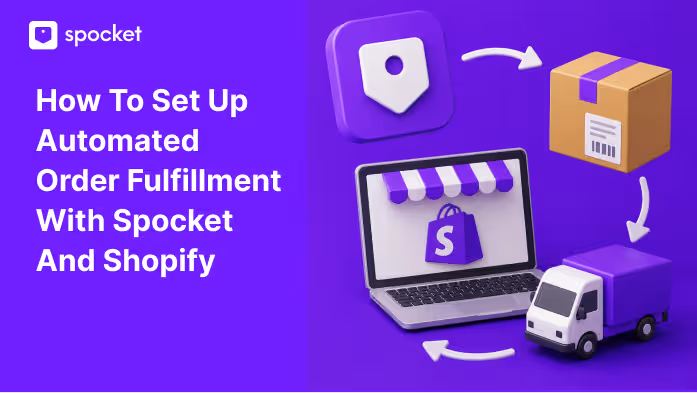
How to Set Up Automated Order Fulfillment With Spocket and Shopify
Set up a smoother Shopify dropshipping workflow with Spocket by connecting your store, importing products, processing orders, syncing tracking, and reducing manual fulfillment tasks.


How to Open a Business Bank Account for Your Dropshipping Store
Set up your dropshipping finances the right way with a dedicated business bank account built for payouts, supplier payments, taxes, and long-term store growth.
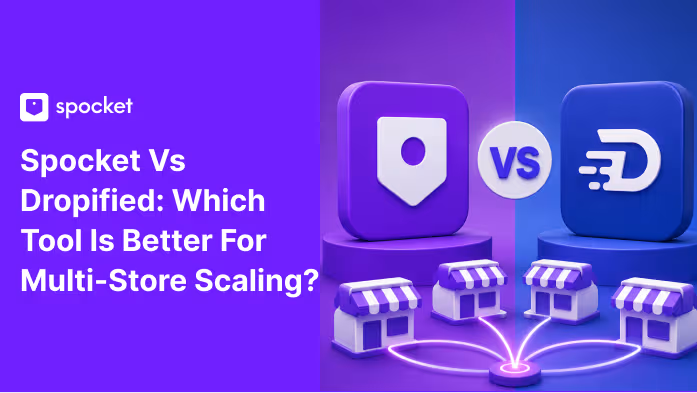
Spocket vs Dropified: Which Tool Is Better for Multi-Store Scaling?
Compare Spocket and Dropified for multi-store dropshipping, supplier quality, automation, fulfillment, product sourcing, and scaling across ecommerce platforms.