¿Cómo encontrar productos ganadores en Spocket en menos de 10 minutos (2026)?
Stop guessing what to sell. This step-by-step guide shows you exactly how to use Spocket's filters to find fast-shipping, high-margin winning products in minutes, not days.

Most dropshippers spend days — sometimes weeks — searching AliExpress, scrolling Reddit, watching YouTube, trying to figure out how to find winning dropshipping products. Then they pick something with 45-day shipping from a Chinese warehouse and wonder why their conversion rate is 0.4%.
There's a faster way. Spocket's product catalog is pre-filtered for US and European suppliers, which means faster shipping and higher perceived quality — but most people don't know how to use the search filters properly.
[🔍 Start your free Spocket trial here] → (no credit card required to browse the full catalog)
This guide walks through the exact steps to go from a blank search to a shortlist of vetted, profitable products in under 10 minutes.
Who this is for: Beginner and intermediate dropshippers who want to cut product research time and find items that actually convert.
What Makes a Product “Winning” Before You Search?
Before you open Spocket, you need to know what you are actually looking for. A winning product is not just something that looks cool. It satisfies four specific criteria that determine whether it will sell profitably and keep your customers happy.
- Shipping speed comes first. Your target market should receive orders within two to seven business days. Anything longer and return rates spike, chargebacks increase, and repeat purchases evaporate. Spocket’s US and EU suppliers solve most of this problem before you even start.
- Margin room matters equally. The retail price should be at least two to three times the Spocket wholesale cost. Aim for a gross margin of thirty to sixty percent. If a product costs you $10 from the supplier, you should be able to sell it for $25 to $35 comfortably without scaring off buyers.
- Problem-solving or desire-driven appeal separates products that sell from products that sit. Items that fix a specific frustration or satisfy a clear want outperform novelty gadgets every time. Think about what keeps your customer up at night or what they brag about to friends.
- Low Amazon saturation determines whether you can actually compete. If Amazon’s top listing has ten thousand reviews and sells the same product for eight dollars, you cannot win on price or trust. Look for items where the top Amazon listing has fewer than five hundred reviews, or where the listing quality is poor enough that your store can out-position it with better copy and images.
Keep this table open while you search — it will save you from bad picks.
The 10-Minute Product Research Method, Step by Step
This section moves fast. Each step takes a minute or less, and the sequence is what makes the method work. Open Spocket in a separate tab and follow along.
Step 1: Go to the Product Search Tab (1 Minute)
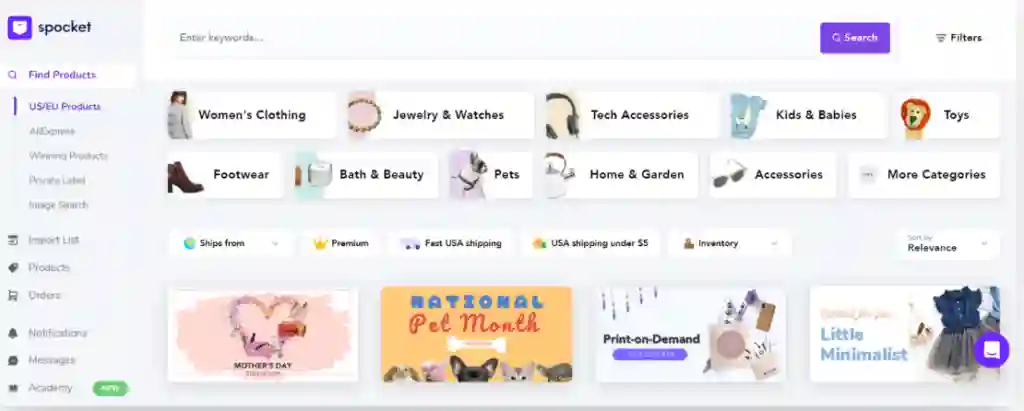
Log into your Spocket account. If you do not have one yet, grab the free trial so you can browse the full catalog without restrictions. From the dashboard, click on the Products tab in the main navigation, then select the Search view. You should see a clean interface with a search bar, category tiles, and a row of filter buttons across the top. This is your starting point. Do not type anything yet.
Step 2: Set Your Shipping Location Filter (1 Minute)
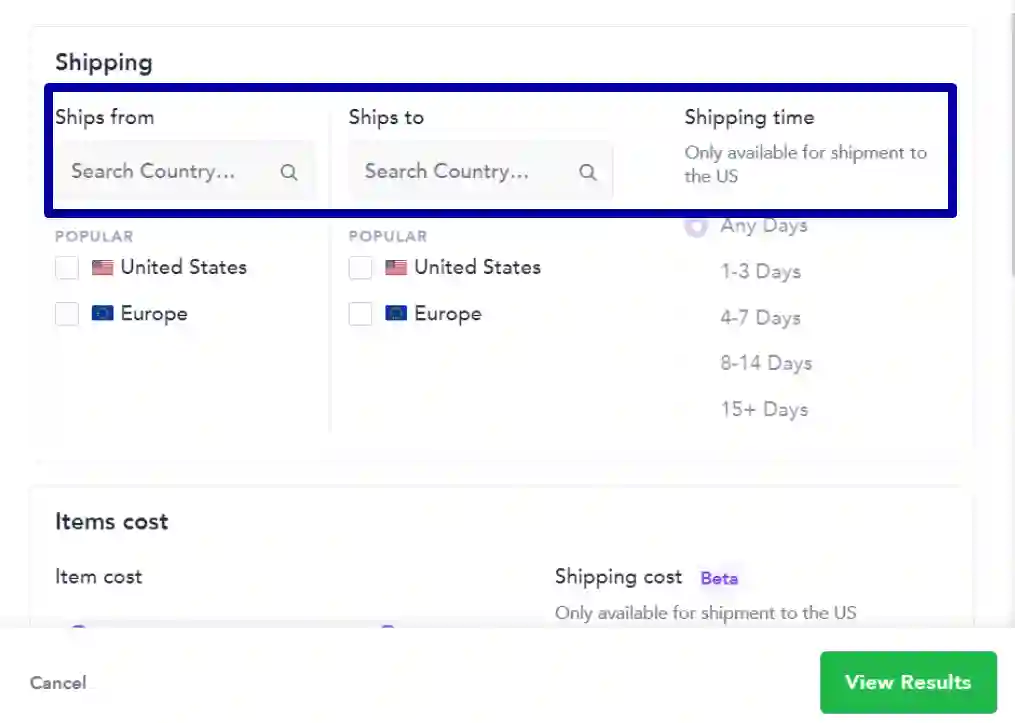
Click the “Ship from” dropdown. Select the United States and Europe, depending on where your customers live. This single filter removes the number one problem new dropshippers face: long delivery times that tank conversion rates and trigger refund requests. US and EU suppliers typically ship within two to seven business days, which matches what Amazon-trained shoppers expect. If you sell primarily to North American buyers, start with the United States only. If you also serve European markets, add those countries. You can always adjust later.
Step 3: Apply the “Premium Suppliers” Badge Filter (30 Seconds)
Toggle on the Premium Suppliers filter. These suppliers have been vetted by Spocket for order fulfillment rate, shipping consistency, and product quality. They are not random vendors who signed up yesterday. The premium badge saves you the time you would otherwise spend checking supplier ratings one by one. This filter reduces your result set to vendors who have a proven track record of reliability.
Step 4: Browse by Category Instead of Searching by Keyword (2 Minutes)
Here is where most people get it wrong. They immediately type a product name into the search bar, which limits them to whatever they already know. Instead, click through the category tiles that Spocket displays. The best categories for beginners include Home & Garden, Bath & Beauty, Pets, and Women’s Accessories. These niches have high average order values, strong visual potential for social media, and products that customers buy on impulse.
Browsing categories surfaces items you would never have thought to search for. It mimics how customers actually shop on real ecommerce sites. You discover products in context, which makes it easier to imagine how they would fit into a curated store. Spend two minutes clicking through two or three categories and scanning what appears. You will start noticing patterns: certain product types repeat across categories, and some suppliers appear frequently. That repetition signals consistent demand.
Step 5: Sort by “Best Sellers” (30 Seconds)
Once you are inside a category, switch the sort order from the default to Best Sellers. This is critical. New Arrivals have no market history. Best Sellers, by contrast, show you products that other Spocket sellers are actively ordering and presumably selling to their customers. Order volume from other store owners is a demand signal you can borrow. It means someone else has already validated that people want this item. You are not guessing, you are following the money.
Step 6: Check the Product Page for Five Specific Signals (3 Minutes)
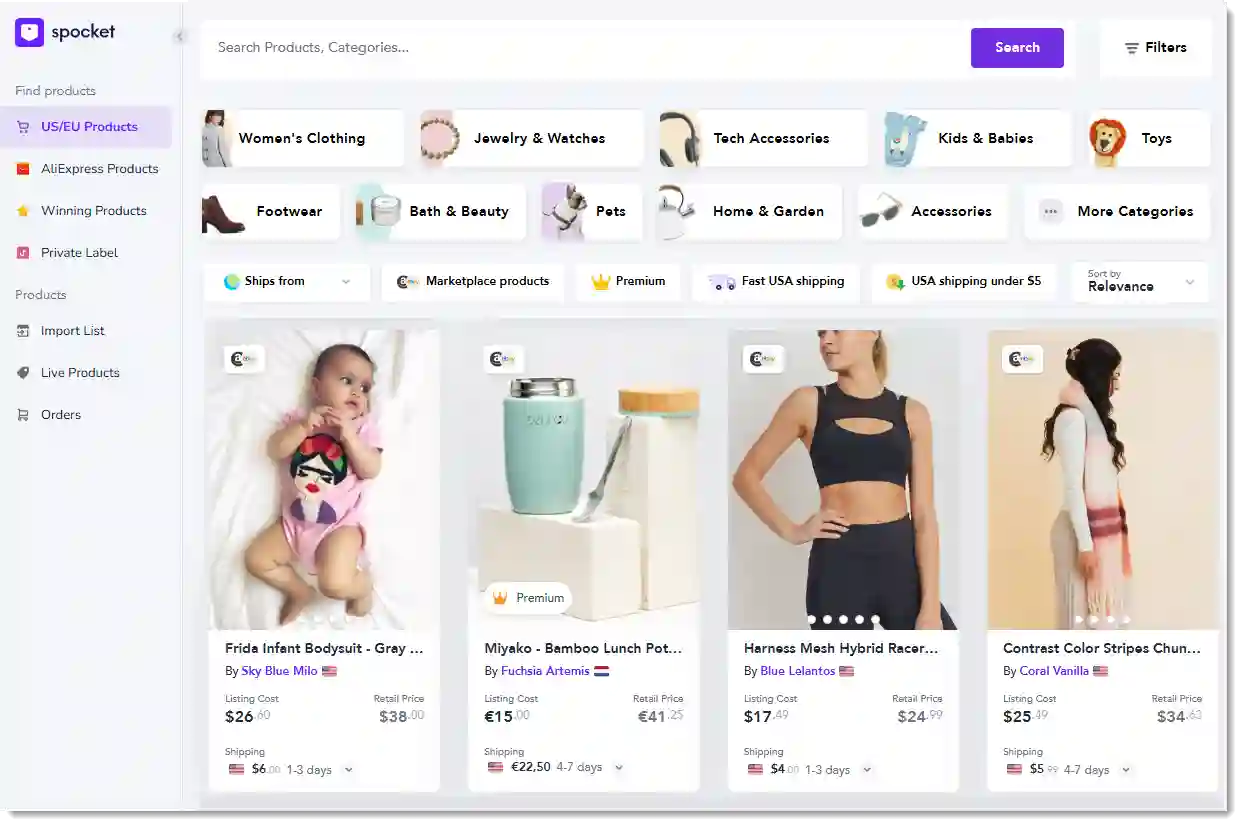
When a product image catches your attention, click through to the full product detail page. Do not get distracted by the photos. Go straight to the information panel and check these five signals in order.
- First, look for the shipping time label. It should clearly state three to seven business days to the US or EU. If it does not, skip the product.
- Second, compare the wholesale price versus the suggested retail price. Is there enough room to mark up two to three times and still land at a price customers would pay? A $6 wholesale item that retails at $25 gives you strong margin. A $15 wholesale item that retails at $22 leaves you almost nothing after ad costs.
- Third, note the number of orders placed by other Spocket users. This is visible on many product pages and acts as social proof. Even a few dozen orders signal that the product moves. Zero orders does not mean a product is bad, but it means nobody else has tested it yet.
- Fourth, evaluate the product images. Are they clean, professional lifestyle shots with good lighting? You will use these images in your store, so they need to look appealing. Blurry or amateur photos hurt your conversion rate.
- Fifth, check the available variants. More sizes and colors give you flexibility to test different combinations and price points. A product with only one variant limits your options.
Step 7: Add to Import List and Repeat (2 Minutes)
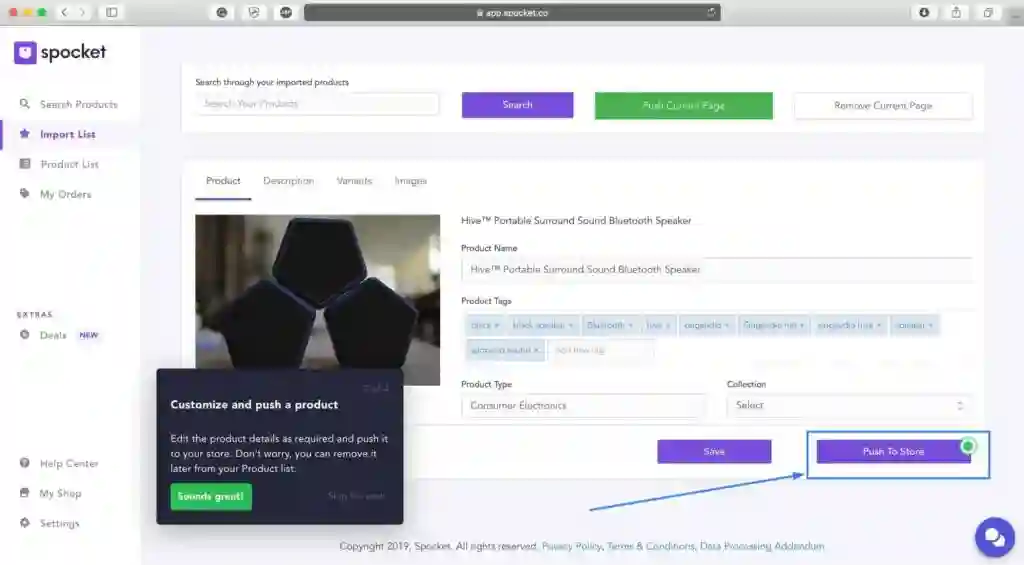
If the product passes all five checks, click the “Add to Import List” button. This saves the product to a holding area where you can review your candidates later. Aim to collect ten to fifteen products in one research session. Do not stop to analyze everything in depth. Move quickly, trust the filters, and build your list. You will narrow it down in the validation stage.
How to Validate Your Candidates Before You List Them?
Your Import List gives you candidates. Validation takes another ten to fifteen minutes and prevents you from listing a dud that wastes ad spend.
Check 1: Amazon Search
Type the product name into Amazon’s search bar. Look at the top organic result. If it has fewer than three hundred reviews or the listing images look amateurish, you have an opportunity. Your store can compete with better branding and product presentation. If Amazon shows hundreds of listings from five to eight dollars with thousands of reviews each, the market is too mature for a new store to enter profitably.
Check 2: Google Shopping Tab
Search the product name followed by “buy online” on Google, then click the Shopping tab. Observe whether existing sellers are running paid ads. Ads confirm that demand exists and that sellers are willing to pay to capture it. Also check the prices other stores are charging. Can you match or beat those prices while maintaining your margin? Can you position your product differently, for example, with a bundle or a better description?
Check 3: TikTok and Instagram Search
Open TikTok or Instagram and search the product name or a related term. Are there organic videos with over 100,000 views? High-view content signals strong consumer interest. Look for creators who are already selling this product through TikTok Shop. If their content quality is low or their product presentation is weak, you have an opening to do a better job with higher-quality images and more engaging copy.
📌 Note: You do not need every validation check to come back green. Two out of three passing is usually enough to justify a small test with a modest ad spend or a few organic social posts. The goal is to avoid obvious losers, not to find a perfect unicorn before you take any action.
Common Mistakes to Avoid
Even with a solid method, a few missteps can derail your product research. Here are the ones that trip up most dropshippers.
- Searching by trend instead of by margin. A product might look exciting because it is popular on social media, but if the wholesale price leaves you with three dollars in profit after shipping and fees, it is not a business opportunity.
- Ignoring supplier response time. Spocket shows how quickly suppliers respond to messages. Under twenty-four hours is good. Over forty-eight hours is a red flag. Slow responses become a problem when you need to resolve an order issue.
- Listing too many products at launch. Five well-chosen products with strong descriptions and good images outperform fifty hastily uploaded items every time. Start small and expand as you learn what your audience buys.
- Skipping the sample order step. Before you scale any product with ad spend, order a sample for yourself. Check the packaging, the actual delivery time, and the quality of the item. What looks great on screen may feel cheap in hand.
- Picking products with no repeat-purchase potential. One-time purchases are fine, but products that customers reorder, such as pet supplies, skincare items, or consumable goods, build a customer base that generates revenue without additional ad spend.
What to Do With Your Shortlist?
Once you have five to ten validated products sitting in your Import List, you can push them directly to your Shopify or WooCommerce store from Spocket with a few clicks. Spocket integrates with both platforms, so you do not need to copy and paste anything manually.
Write original product descriptions for each item. Supplier copy is often generic, and duplicate content does not help your store rank or convert. Describe the product in your own voice and focus on how it solves a problem or fits into the customer's life.
📌 Note: Need help? Check out our guide on writing product descriptions that convert.
Price each product for at least forty percent gross margin after accounting for the wholesale cost, shipping, and payment processing fees. If the numbers do not work, remove the product from your list and move to the next one.
Note for free plan users: Si alcanzas los límites de importación en el plan gratuito, consulta la página de precios de Spocket aquí para comparar opciones.
Prueba un producto a la vez. Lanza una pequeña campaña publicitaria de diez a veinte dólares al día, o publica contenido orgánico en tus redes sociales y haz un seguimiento de la interacción. Deja que los datos, no la emoción, decidan si un producto merece más inversión.
¿Nuevo en Shopify? [Aquí tienes una guía para principiantes sobre cómo configurar una tienda Shopify.
Conclusión
Encontrar un producto ganador no es cuestión de suerte ni de pasar horas inmerso en la investigación. Aplica los filtros correctos en la secuencia adecuada: proveedores de EE. UU. y la UE, insignia Premium, orden de clasificación de los más vendidos y las cinco señales de la página del producto. Esa secuencia te lleva de una búsqueda en blanco a una lista preseleccionada validada en diez minutos o menos. El método funciona siempre porque elimina el inventario deficiente antes de que tengas la oportunidad de encariñarte con él.
Si aún no has probado Spocket, el plan gratuito te permite explorar el catálogo completo y crear una lista de importación sin introducir una tarjeta de crédito. Entonces, ¿a qué esperas? Empieza tu prueba gratuita ahora.
Start your dropshipping business today
¿Cómo encontrar productos de dropshipping ganadores? Preguntas frecuentes
¿Qué hace que un producto de dropshipping sea un «ganador»?
Un producto ganador resuelve un problema real o satisface una necesidad importante. Se envía rápidamente desde proveedores de EE. UU. o de la UE, no desde China. Necesitas al menos un 40 % de margen bruto, lo que significa que puedes venderlo por 2 o 3 veces tu coste. Consulta también Amazon. Si el anuncio principal tiene miles de reseñas y se vende barato, descártalo.
¿Cómo valido un producto antes de venderlo?
Pide una muestra a tu proveedor. Comprueba tú mismo la calidad, el embalaje y la velocidad de envío. Realiza una pequeña prueba publicitaria en Meta durante tres días con diez a veinte dólares diarios. Observa si la gente hace clic y compra. Busca también el producto en Amazon. Si ves poca competencia y demanda real, estás listo para empezar.
¿Qué margen de beneficio debo buscar?
Debes aspirar a un margen bruto de al menos el 40 %. Esto significa que tu precio de venta al público es aproximadamente 2 o 3 veces el coste de tu proveedor. Si pagas 10 $ por un producto, véndelo por 25 $ a 35 $. Después de pagar los anuncios y las tarifas, tu margen neto debe mantenerse por encima del 20 %. Cualquier cosa por debajo del 20 % es demasiado arriesgada.
¿Cuáles son las mejores herramientas para la investigación de productos?
Existen buenas herramientas para la investigación de productos. Spocket te ayuda a encontrar proveedores de EE. UU. y la UE con envío rápido. Minea es excelente para comprobar anuncios virales en TikTok. Niche Scraper y Dropshiptool te permiten espiar las tiendas de la competencia. Utiliza varias de ellas juntas para detectar artículos de tendencia antes de que se saturen.
¿Qué errores comunes debo evitar?
No persigas gadgets virales solo porque se vean geniales. Así es como pierdes dinero. Evita productos con largos tiempos de envío desde China. Eso mata tu tasa de conversión. No publiques cincuenta productos a la vez. Empieza con cinco artículos bien elegidos y pruébalos primero con pequeños presupuestos publicitarios.
¿Cómo identifico productos en tendencia rápidamente?
Explora las secciones de "Más vendidos" en las plataformas de proveedores en lugar de buscar palabras clave al azar. Busca artículos que ya tengan pedidos de otros dropshippers. Eso es una señal de demanda real. Revisa TikTok e Instagram para ver productos con un alto número de visualizaciones. Si ves anuncios de baja calidad para un buen producto, ahí está tu oportunidad.
¿Cómo analizo a mi competencia?
Busca productos similares en Amazon y Google Shopping. Mira cuántas reseñas tienen los competidores y cuánto cobran. Si el listado principal de Amazon tiene menos de 300 reseñas, es una buena señal. Puedes competir con una mejor marca y presentación de la tienda. Si todo el mundo vende lo mismo por 8 $, sigue adelante.
¿Cuáles son los mejores nichos de dropshipping ahora mismo?
Los productos de bienestar para mascotas son sólidos. Los artículos de organización del hogar y los gadgets de cocina también funcionan bien. Los artículos de belleza y cuidado personal tienen buenos márgenes, a menudo del 50-70%. Los accesorios para el hogar inteligente y los productos de salud también muestran una fuerte demanda. Elige un nicho en el que puedas concentrarte, no solo cosas al azar. Eso te ayuda a construir una marca real.
¿Cómo pongo precio a mis productos correctamente?
Calcula tu coste total primero. Eso incluye el precio del proveedor más los gastos de envío y las comisiones por transacción. Luego multiplica esa cifra por 2.5 a 3 veces para establecer tu precio de venta al público. Comprueba lo que cobran los competidores y asegúrate de no estar mucho más alto. Utiliza precios basados en el valor, lo que significa que si un producto ahorra tiempo a la gente o resuelve un problema, puedes cobrar más.
¿Cómo encuentro proveedores fiables?
Busca proveedores con sede en EE. UU. o Europa. Envían mucho más rápido que los chinos. Utiliza plataformas que verifiquen a los proveedores por ti, como Spocket o SaleHoo. Antes de comprometerte, pide una muestra para comprobar la calidad del producto. Prueba también la velocidad de su servicio al cliente. Si tardan dos días en responder a una pregunta, eso es una señal de alarma.
¿Cómo pruebo un producto con anuncios de Facebook o Meta?
Configura una campaña de ventas manual con un presupuesto diario de veinte dólares. Prueba el producto durante tres días y observa tus tasas de clics y conversión. Si obtienes ventas a un buen coste, puedes escalarlo. Si nadie hace clic o compra, cancela la campaña y pasa al siguiente producto. Deja que los datos decidan, no tus sentimientos.


Launch your dropshipping business now!
Start free trial.avif)


Blogs relacionados
Directorio de proveedores de dropshipping: dónde encontrar proveedores verificados
Explora nuestro directorio de proveedores de dropshipping verificados en EE. UU. y la UE, con información sobre nichos, tiempos de envío y precios. Comienza tu prueba gratuita hoy mismo.

Cómo negociar con proveedores de dropshipping: 9 tácticas que realmente funcionan
Aprende a negociar precios, cantidades mínimas de pedido (MOQ) y condiciones de pago con tus proveedores de dropshipping. Utiliza tácticas probadas y plantillas de correo para aumentar tus márgenes. Prueba Spocket gratis.

Los mejores proveedores de dropshipping de ropa: La guía 2026
Compara los mejores proveedores de dropshipping de ropa para 2026 (velocidad de envío en EE. UU./UE, precios y calidad del producto) y encuentra el socio ideal para lanzar tu tienda.