How to Start a Faceless YouTube Channel (and Make Money From It)
Learn how to start a faceless YouTube channel step-by-step, pick profitable niches, create videos with AI, and monetize with ads, affiliates, and ecommerce using Spocket.
.avif)

A faceless YouTube channel is exactly what it sounds like: you publish videos without showing your face. You can use voiceovers (your own or AI), screen recordings, stock footage, animations, slides, or text-based storytelling. And yes—this format can absolutely make money online when you build it like a real media business, not a one-off experiment.
Faceless channels work because YouTube rewards viewer satisfaction more than it rewards personality. If your content keeps people watching, solves a problem, or delivers entertainment consistently, the algorithm doesn’t care whether your face is in the frame.
This guide is a complete, practical blueprint: from picking a niche to producing videos quickly, and from getting views to turning them into real revenue—ads, affiliates, sponsorships, and ecommerce.
What counts as a faceless YouTube channel?
A “faceless channel” can be any of these formats:
- Voiceover + visuals (stock footage, b-roll, screenshots, clips)
- Screen recordings (tutorials, tools, websites, gameplay)
- Text-on-screen storytelling (Shorts and fast reels-style videos)
- Animated explainers (simple motion graphics, whiteboard style)
- Compilation formats (with original structure + commentary)
- AI-assisted narration (with careful quality control)
The advantage is privacy and speed. The trade-off is you must make the content itself the star: better scripting, tighter editing, stronger hooks, and consistent publishing. This is exactly why many faceless creators lean on AI for scripting and voice workflows—because the “production system” matters more than on-camera charisma.
Step-by-Step Blueprint to Launch and Scale a Profitable Faceless YouTube Channel
Before you worry about monetization, you need structure. The difference between faceless channels that quietly disappear and those that turn into real income streams is not talent — it’s system design.
The steps below walk you through choosing the right niche, locking in a repeatable format, building a recognizable brand identity, and creating an AI-assisted workflow that allows you to publish consistently without burning out.
Step 1: Pick a faceless niche that can monetize
Most faceless channels fail for one reason: they pick a niche that either can’t monetize well or can’t be produced consistently. A profitable faceless niche usually has at least two of these traits:
- High search demand (people actively looking for it)
- Repeatable video formats (so you can batch production)
- Strong ad rates or buyer intent (so revenue per view is higher)
- Clear community identity (so subscribers return)
High-performing faceless niche categories
Here are niche “buckets” that work especially well without showing your face:
- Educational explainers: Short lessons, “how it works,” myths vs facts, beginner guides.
- Tutorials and how-tos: Screen recording content is naturally faceless and evergreen.
- Reviews and comparisons: Tool reviews, product comparisons, “best of” lists—great for affiliate monetization.
- Gaming: Gameplay, walkthroughs, lore explainers, tips and builds.
- Relaxation / ASMR / ambience: Music, soundscapes, background ambience—faceless by default.
Quick niche test (5 minutes)
Before you commit, run this mini-test:
- Search your niche on YouTube.
- Open 10 videos from smaller channels (not just huge ones).
- Look for: consistent uploads, high views per video, similar repeatable formats.
- Check if the niche supports multiple monetization paths (ads + affiliates + products).
If you see channels earning attention with a consistent format, you can replicate the structure—then differentiate with better scripting and packaging.
Step 2: Choose your faceless format (don’t overcomplicate it)
Pick ONE primary format and stick to it for your first 30 videos. Consistency is your unfair advantage.
Best beginner formats
- Format A: Voiceover + stock footage (long-form): Great for explainers, storytelling, and educational content.
- Format B: Screen recording tutorials (long-form or Shorts): Great for software, apps, workflows, and “how to do X” videos.
- Format C: Text-on-screen Shorts: Fast to produce, high volume testing, good for early growth.
Select a format that matches your niche and then build a strategy around consistent visuals and a reliable production workflow.
Step 3: Set up your channel like a brand (not a personal account)
Even a faceless channel needs branding—just not personal branding.
Channel setup checklist
- Channel name that signals the niche clearly (avoid vague names)
- Banner + logo that matches the niche and is readable on mobile
- “About” section: what you publish, who it’s for, upload cadence
- Create 3–5 playlists from day one (structure helps binge watching)
- A simple thumbnail style guide (same fonts, same layout logic)
This is also where you make money later: brand clarity increases clicks, clicks lead to watch time, and watch time drives distribution.
Step 4: Build an AI-assisted production workflow (that still feels human)
AI can help you move faster—especially when you’re publishing frequently. But the goal is not “AI videos.” The goal is high-retention videos produced efficiently. Use AI tools for scripting and voice, then combine voiceover with strong visuals using editing software.
A clean workflow that scales
1) Topic research (30–45 mins)
- Use YouTube search suggestions
- Use “People also watched” and competitor video titles
- Keep a list of 50 ideas
2) Outline (10 mins)
- Hook
- 3–5 key points
- Examples
- Quick summary
3) Script writing (20–40 mins)
- Write for spoken language (short sentences, clear transitions)
- Build curiosity loops every 20–30 seconds
- Remove fluff
4) Voiceover (10–20 mins)
- Use your voice for uniqueness, or AI voice if needed
- Keep pacing energetic but natural
5) Visuals + edit (60–120 mins)
- Stock footage, screenshots, screen recordings, simple animations
- Add captions (especially for Shorts)
- Keep transitions tight
6) Thumbnail + title (20 mins)
- Thumbnail = one idea, high contrast, minimal text
- Title = keyword + benefit
7) Publish + improve (15 mins)
- Pin a comment
- Reply to early comments
- Note retention dips and fix in the next video
This workflow is why faceless channels can become a serious side hustle: you can batch steps and produce multiple videos in one sitting.
Step 5: Make videos people actually watch (retention is everything)
Most creators obsess over subscribers. You should obsess over retention.
The retention formula (simple, effective)
- Hook in the first 5 seconds (tell them what they’ll get)
- Deliver value every 10–20 seconds (no long intros)
- Pattern breaks every 30–45 seconds (visual change, on-screen text, example)
- Use micro-stories and examples (keeps attention)
- End with a reason to watch the next video (playlist / next topic)
Faceless creators win when their scripts are better than average—because the script is the personality.
Step 6: YouTube SEO for faceless channels (how to get discovered)
YouTube is both a social platform and a search engine.
What to optimize (without overthinking)
Titles
- Put the keyword early
- Add a clear benefit/outcome
- Avoid clickbait that disappoints
Descriptions
- First 2 lines: summarize the value + keyword naturally
- Add chapters/timestamps for long videos
- Add your links (affiliate, store, newsletter)
Tags
- Use a few exact-match tags and variations (not 50 random tags)
Playlists
- Organize content so viewers binge-watch
- Binge = more watch time = algorithm love
How to Make Money With a Faceless YouTube Channel
This is the part everyone cares about, and it’s also where most creators think too narrowly. Ad revenue is only one path. The best faceless channels stack multiple income streams so you’re not dependent on one metric.
Monetization path 1: YouTube Partner Program ads
To earn ad revenue through the YouTube Partner Program (YPP), YouTube lists eligibility thresholds such as 1,000 subscribers plus either 4,000 valid public watch hours in the last 12 months OR 10 million valid public Shorts views in the last 90 days. YouTube also notes that Shorts watch hours don’t count toward the 4,000 watch hours threshold.
Important reality check:
- Ads become meaningful when you have consistent views
- RPM varies by niche, audience location, and video type
- Long-form often monetizes more predictably than Shorts (but Shorts can grow you fast)
Monetization path 2: Affiliate marketing (fastest early income)
Affiliate marketing often pays before ads do, because you can earn with small traffic—if the audience has buying intent.
Best affiliate-friendly faceless niches:
- Software and AI tools
- Ecommerce tools
- Productivity and business workflows
- “Best X” product lists
How to do it well:
- Review tools you actually use
- Compare options honestly
- Give clear “who it’s for” recommendations
If your channel is ecommerce-focused, you can naturally recommend Spocket in videos about product sourcing, dropshipping strategy, or print-on-demand workflows.
Monetization path 3: Sponsorships and brand deals
Once you have consistent views in a niche, brands pay for:
- integrated mentions
- dedicated reviews
- Shorts sponsorship packages
Even a smaller channel can get sponsorships if the niche is valuable and the audience is targeted.
Monetization path 4: Sell digital products (low effort, scalable)
This is where “passive income” starts to become real. Examples:
- Notion templates
- Prompt packs
- Guides and checklists
- Mini-courses
- Script templates for other creators
Digital products work especially well with faceless channels because you’re already teaching or structuring information.
Monetization path 5: Ecommerce with Spocket (sell without inventory)
If you want a monetization method that isn’t tied to YouTube’s approval timeline, ecommerce is a strong path—especially when you can fulfill without holding stock.
Two ways Spocket fits naturally:
Option A: Print-on-demand merch for your channel
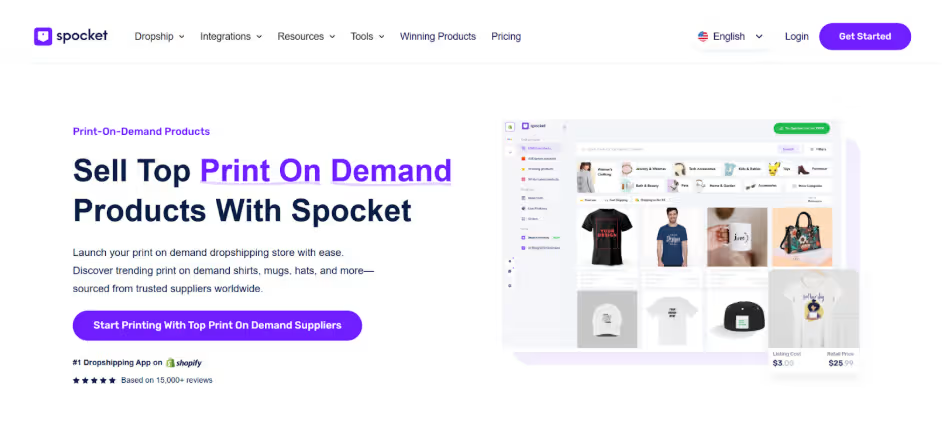
Sell niche merch tied to your content:
- Quotes and inside jokes (for your community)
- Niche identity designs (hobby/profession merch)
- Minimalist designs for broader appeal
Spocket offers print-on-demand products you can sell without holding inventory, which is ideal when you’re starting and want to make money without investment (or at least without buying stock upfront).
Option B: Dropship complementary products
If your channel is product-focused (home, pets, fitness, decor), you can:
- recommend products in videos
- link to your store
- fulfill through Spocket’s supplier network
This turns views into purchases without needing a warehouse.
Monetization path 6: Services (if you want fast cashflow)
Faceless channels can also generate leads for services like:
- video editing
- script writing
- channel management
- thumbnail design
- SEO consulting
This is one of the fastest ways to turn attention into income—especially early.
A simple 30-day plan to launch your faceless channel
If you want something you can follow without getting overwhelmed:
Week 1: Foundation + first videos
- Pick niche + format
- Create channel branding
- Publish 3 videos (don’t wait for perfection)
Week 2: Consistency + improvement
- Publish 3–4 more videos
- Improve hooks and thumbnails
- Build playlists
Week 3: Start monetization stack
- Add affiliate links where relevant
- Create a simple free lead magnet (checklist)
- Start collecting emails (optional but powerful)
Week 4: Publish and iterate
- Publish 4–6 videos
- Review retention graphs
- Double down on topics with higher watch time
You don’t need fancy gear. You need output, learning, and consistency.
Common mistakes that kill faceless channels
Even though faceless YouTube channels remove the pressure of being on camera, they still fail for very predictable reasons. Most creators don’t lose because of the algorithm—they lose because of inconsistent posting, weak scripting, poor retention strategy, or unclear monetization plans.
Understanding these common pitfalls early helps you avoid wasted months and build a channel that grows steadily instead of stalling after a few uploads.
Copying without adding value
If your channel looks like a clone, it won’t stand out. Use the same structure, but improve:
- clarity
- pacing
- examples
- editing polish
Overusing AI without quality control
AI is great for speed, but viewers notice low-effort scripts and robotic voice pacing. Human polish is the difference.
Making videos without a “why”
Every video should answer:
- What problem does this solve?
- Why should someone watch this version?
No monetization plan until “later”
You can begin monetization early via affiliates, email lists, and ecommerce—ads are not the only route.
Conclusion
A faceless YouTube channel is one of the most realistic ways to build a scalable content business without stepping on camera. The winning formula is simple: pick a niche you can sustain, commit to one repeatable format, publish consistently, and improve based on retention data.
If your goal is income, build a monetization stack early—ads later, but affiliates, sponsorships, and ecommerce sooner. And if you want a product-based path that doesn’t require inventory, Spocket can help you monetize your audience with print-on-demand or dropshipping products while keeping operations lightweight.
Start your dropshipping business today
FAQs About Starting a Faceless YouTube Channel
Can you monetize YouTube without showing your face?
Yes. You can qualify for YPP using Shorts or long-form thresholds and monetize through ads, affiliates, sponsorships, and products. YouTube’s eligibility thresholds include 1,000 subscribers plus either watch hours (long-form) or valid Shorts views.
What is the best niche for a faceless YouTube channel?
The best niche is one you can produce consistently and that has clear audience demand. Educational explainers, tutorials, reviews, gaming, and relaxation formats are common faceless niches because they don’t require on-camera presence.
How do faceless YouTubers make money besides ads?
Affiliate marketing, sponsorships, digital products, and ecommerce are the big ones. Ecommerce can work well when you can fulfill without inventory—like selling print-on-demand products through Spocket.
Do I need expensive tools or editing skills to start?
No. Start with a simple workflow and improve as you go. Many creators use AI to speed up scripting and voiceover, then combine it with basic editing and strong visuals.
How fast can a faceless channel start earning?
It depends on niche and consistency. Ads require YPP eligibility, but affiliate links or product sales can generate revenue earlier if your content targets buyer intent.


Launch your dropshipping business now!
Start free trial


Related blogs
Dripshipper Reviews: Is This Coffee Dropshipping Platform Worth It?
Read this detailed Dripshipper review covering features, pros, cons, pricing, customer feedback, profitability, and better dropshipping alternatives.

Is BigBuy Legit? Honest Review for Dropshipping Businesses
Find out if BigBuy is a reliable dropshipping supplier, including its features, pros, cons, pricing concerns, reviews, and alternatives for ecommerce sellers.
What is Micromarketing and How to Use it Effectively
Learn what micromarketing is, how it works, its benefits, examples, and how ecommerce businesses can use it to target niche customers effectively.