Qikink Review: What to Expect From This Print-on-Demand Partner
Read this Qikink review to understand product quality, shipping speed, print results, integrations, pricing, and whether it’s a reliable print-on-demand partner.

.avif)

If you’re researching Qikink, you’re probably trying to answer one core question: Is it reliable enough to build a real print-on-demand business on top of it? This Qikink review is written to help you decide with fewer guesses and more practical clarity—what Qikink does well, where sellers commonly struggle, what the real workflow looks like, and the best way to test it before you scale.
Qikink positions itself as a print-on-demand and fulfillment partner with an ecosystem that supports common ecommerce workflows. At the same time, “print-on-demand” is only as good as the outcomes: print quality, packaging, delivery timelines, support responsiveness, and how smoothly orders move from your store to production and shipping. So instead of repeating generic POD explanations, this review focuses on what matters when you’re trying to build a profitable side hustle, develop passive income, and avoid painful refund cycles.
Throughout the article, I’ll reference Qikink’s official materials along with a third-party review analysis that summarizes performance factors.
What Qikink is and who it’s best for
Qikink is a print-on-demand service that enables sellers to offer customized products (like apparel and accessories) without holding inventory. In a standard setup, you list products on your store, a customer places an order, and Qikink handles production and shipping.
Who tends to benefit most
Qikink is usually a good fit for:
- New brands that want to launch small and scale gradually
- Sellers who prioritize a simple catalog over massive product variety
- Merch creators who want repeatable fulfillment once they find winning designs
- Store owners who want a workflow that integrates with common ecommerce platforms
Who should be cautious
You should be more cautious if:
- Your brand promise requires ultra-fast delivery everywhere
- You plan to offer complex customization options beyond standard POD flows
- Your niche has high size-sensitivity (apparel) and you can’t invest in sampling first
Quick verdict: is Qikink legit and trustworthy
Based on publicly available customer feedback and marketplace reviews, Qikink appears to have a real operating footprint and an active user base — but with mixed experiences, which is typical for print-on-demand services.
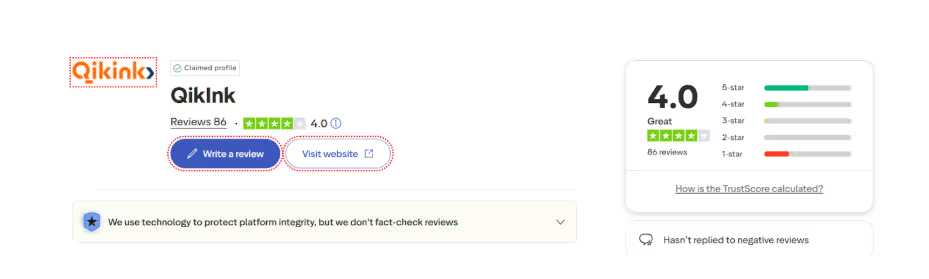
On trustpilot, Qikink currently holds an overall rating of 4.0 out of 5 stars, based on 70+ reviews at the time of writing. This suggests a generally positive experience for a majority of users, though the total review volume is still relatively modest.
On the Shopify App Store, the rating is lower (around the low 3-star range), with fewer total reviews. Lower app ratings often reflect merchant-side concerns such as integration stability, syncing issues, onboarding friction, or operational delays — rather than end-customer satisfaction.
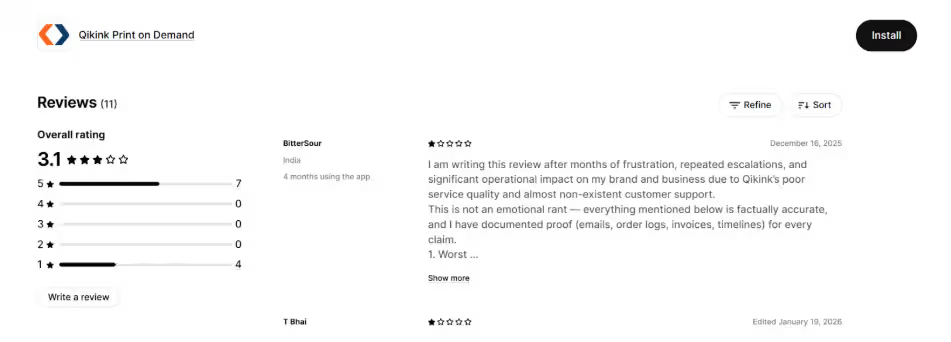
This difference between consumer-style reviews and app marketplace reviews is not unusual. App store ratings tend to be stricter because merchants evaluate automation, API reliability, and workflow efficiency — not just product quality.
Practical takeaway
Qikink appears to be a legitimate POD provider with a solid number of satisfied users. However, it should not be treated as a plug-and-play solution without testing.
If you plan to build a serious brand:
- Order multiple samples before launching ads
- Clearly display realistic shipping timelines
- Create a structured customer support workflow
- Start with a small SKU range and scale proven products
Your profitability and reputation will depend less on the platform alone and more on how carefully you validate quality and manage expectations.
How Qikink works: the real print-on-demand workflow
Here’s what the typical workflow looks like in real store operations.
- You create designs (or outsource them)
- You create products in your POD dashboard
- You push listings to your ecommerce store
- Customers place orders on your storefront
- Orders sync (automatically, if integrated) to Qikink
- Qikink produces items and ships them
- Tracking details are generated and ideally sent back to your store/customer
1. Product catalog and customization options
Most POD sellers care about two things:
- Can I find products my customers want?
- Can I customize them cleanly and consistently?
Qikink typically supports popular POD staples such as apparel and accessories. Exact catalog breadth can change over time, so it’s best to browse the current catalog directly on the official site before committing to a niche.
What to check before choosing products
Even if a product looks good on a catalog page, validate:
- Print area size and positioning
- Color availability by size
- Fabric composition and GSM (for apparel)
- Shrinkage notes and wash durability
- Variant structure (how it maps to your storefront)
If your store is built on “premium quality,” sampling isn’t optional—it’s part of your brand protection.
2. Print quality: what sellers commonly report
Print quality is the biggest make-or-break factor for any POD provider.
Testing factors such as print output, packaging, delivery, and performance—useful if you want a structured summary of what to evaluate.
Meanwhile, customer feedback on a public review profile shows a mixed set of experiences, with enough volume to indicate real usage and recurring themes.
How to judge quality correctly
Don’t rely on one sample. Run a small test batch:
- 1 black tee (white print + color print)
- 1 light-colored tee (color print)
- 1 hoodie/sweatshirt (larger print area)
- 1 accessory (mug/case if relevant)
Evaluate:
- Color vibrancy and sharpness
- Alignment (centered, consistent)
- Feel of the print after curing (not sticky)
- Wash test after 3 cycles
If your niche is fashion-forward, the “hand-feel” of fabric matters as much as the print.
3. Shipping speed and delivery expectations
Shipping is the second major reason POD stores get refunds. Even a great print won’t save a customer experience if delivery is late and communication is vague.
Qikink’s integration pages and general ecommerce workflows emphasize automated processing, but actual delivery timelines still depend on:
- Production time (printing + packing)
- Carrier performance
- Destination region
Customer feedback on the public review profile includes shipping and service experiences that vary—again, typical of POD where expectations differ by seller and market.
Best practice: set expectations on every product page
If you want fewer “Where is my order?” tickets, display:
- Production time range
- Shipping time range by region
- Tracking availability
- Cutoff times (if any)
This is how established POD brands protect margins: fewer refunds, fewer disputes, better reviews.
4. Packaging and branding: does it feel premium
Your customers don’t care that you’re dropshipping or using POD. They judge your brand. Packaging is part of that. When reviewing packaging, ask:
- Is it protective enough for the product type?
- Does it arrive clean and undamaged?
- Is there branding support (inserts/labels) depending on your plan/options?
- Does it look “giftable” or purely utilitarian?
If your brand is premium, you can also “upgrade” the unboxing experience by:
- Adding branded emails and post-purchase flows
- Including digital inserts (thank-you message + discount code)
- Packaging-friendly product selection (items less prone to transit damage)
5. Integrations: Shopify and beyond
Integrations matter because automation is where dropshipping becomes scalable.
Shopify
Qikink has a Shopify app listing that describes product import, fulfillment, and order management features. Qikink also has an official Shopify integration page that discusses workflow automation and product push features.
WooCommerce
There’s also a WooCommerce plugin listing describing an API-based workflow where products and orders sync between WooCommerce and Qikink.
What to check before you rely on automation
- How variants are mapped (size, color)
- Whether cancellations/edits sync both ways
- Whether tracking syncs automatically to the storefront
- Whether combo/bundled products are supported
- How out-of-stock situations are handled
App store ratings can reflect these friction points, so treat them as signals for what to test first.
6. Pricing and margins: how to make Qikink profitable
Pricing in POD is always a balance:
- Your base cost (production)
- Shipping costs
- Marketing costs (ads/influencers/content)
- Refund buffer
Your margin isn’t “price minus cost.” It’s what’s left after the real-world messiness.
A simple margin formula you can use
Profit per order = Selling price − (base cost + shipping + transaction fees + average ad cost per order + refund buffer)
For your refund buffer, even a conservative 2–5% allocation helps protect cash flow.
Margin tips that work for POD
- Start with fewer SKUs and go deeper on winners
- Sell bundles (2 tees, 3 tees) once quality is proven
- Use “premium positioning” only if your samples truly support it
- Avoid over-discounting early—it trains customers to wait for sales
This is how POD becomes a sustainable side hustle and not a burnout machine.
7. Customer support: what you should expect
Support quality is hard to measure without using the service. But public customer feedback gives clues about response experience and issue resolution patterns.
How to protect yourself regardless of support quality
Build your own support system:
- Create templates for delays, misprints, returns
- Require photo evidence for quality issues
- Keep a “resolution policy” (reprint vs refund)
- Communicate timelines proactively
If you rely purely on supplier support, your brand experience becomes unpredictable.
Pros and cons of Qikink
Here’s a balanced look at what Qikink does well — and where it can fall short — so you can decide whether it fits your business model, niche, and quality standards. This section highlights real strengths and common pain points based on user feedback and integration experiences, helping you set the right expectations before you commit to scaling with it.
Pros
- POD workflow designed for ecommerce selling
- Integration options (Shopify and WooCommerce paths are visible publicly)
- Review footprint suggests real usage and ongoing feedback cycles
Cons
- App marketplace ratings indicate mixed merchant experience (often integration or operations-related)
- POD fulfillment outcomes can vary by product type and expectation setting
- Shipping and support expectations need careful management, especially if your audience expects fast delivery
Qikink vs Spocket: which is better for what
This is where many sellers get confused, so here’s a clean way to think about it.
- Qikink is primarily a print-on-demand fulfillment partner (you sell custom products you design).
- Spocket is typically used to source ready-to-sell products from suppliers (often with strong US/EU options depending on selection), which is more classic dropshipping. (If your goal is custom branded merch, POD is the core. If your goal is curated products without customization, supplier marketplaces shine.)
When Qikink is the better fit
- You want to build a merch brand
- You have original designs or creator IP
- You want repeatable product lines like tees/hoodies
When Spocket is the better fit
- You want to launch a curated store quickly
- You want a broader catalog beyond POD staples
- You want to test product-market fit across categories
Many brands use a hybrid: Spocket for general catalog and Qikink for custom merch drops.
How to test Qikink before committing
If you want to avoid the biggest POD mistakes, follow this structured test.
Phase 1 - Sample testing
Order 4–6 samples that represent:
- Different fabrics
- Different print colors
- Different print placements
Document:
- Photos under natural light
- A wash test result
- Delivery timeline from order to doorstep
Phase 2 - Micro launch
Run a micro launch to 20–50 orders (not 500).
- Limit SKUs
- Limit regions (if possible)
- Track support tickets and issue types
Phase 3 - Scale only what stays stable
Scale the products with:
- The lowest complaint rate
- The fastest production consistency
- The strongest repeat purchase rate
This is the difference between “trying to make money online” and actually building stable passive income potential.
Best use cases for Qikink
Qikink tends to work best for:
- Creator merch (YouTube, Instagram, community brands)
- Niche apparel with a clear identity (gym humor, pet niches, local pride)
- Event and team merch
- Seasonal campaigns (festivals, gifting)
If you want to use POD as a way to make money without investment in inventory, this is one of the cleanest business models—provided you handle quality control responsibly.
Final verdict
Qikink looks like a legitimate POD option with public-facing integrations and a meaningful footprint of user feedback.
However, the difference between success and chaos will be your setup discipline: sample testing, realistic shipping promises, and a customer support process that protects your brand.
If your goal is custom merch and brand-building, Qikink can be worth testing. If your goal is broader product variety and faster experimentation across categories, pairing your store strategy with Spocket for non-custom items can be a smart complementary route.
Start your dropshipping business today
FAQs about Qiknik
Is Qikink a reliable print-on-demand provider?
Qikink is a legitimate print-on-demand service used by many online sellers, and it has a generally positive consumer rating. However, experiences vary, and reliability depends on product type, shipping destination, and how well you set customer expectations. Always test samples before selling at scale.
Can Qikink integrate with popular ecommerce platforms?
Yes — Qikink offers integration options, including workflows for major platforms that allow you to sync products and automate order routing. Make sure you follow integration instructions carefully because variant mapping and stock syncing require proper setup for smooth fulfillment.
How long does Qikink take to fulfill and ship orders?
Fulfillment and shipping times depend on the product and destination. Production can take several business days, and delivery varies by carrier and region. Displaying realistic production and delivery estimates on your product pages reduces support issues and disappointed customers.
Do customers need to pay additional fees for customization?
Product pricing usually includes base printing costs and any customization you select. Shipping charges are often separate. Factor both into your pricing strategy and communicate clearly on product pages to avoid surprises at checkout.
What should I do if a customer receives a damaged or incorrect item?
Establish a clear support and resolution policy upfront. Request photos and order details, contact Qikink support if needed, and decide whether you’ll offer a reprint, refund, or store credit. Clear policies and quick responses help retain trust and reduce chargebacks.


Launch your dropshipping business now!
Start free trial


Related blogs

Dripshipper Reviews: Is This Coffee Dropshipping Platform Worth It?
Read this detailed Dripshipper review covering features, pros, cons, pricing, customer feedback, profitability, and better dropshipping alternatives.

Is BigBuy Legit? Honest Review for Dropshipping Businesses
Find out if BigBuy is a reliable dropshipping supplier, including its features, pros, cons, pricing concerns, reviews, and alternatives for ecommerce sellers.

What is Micromarketing and How to Use it Effectively
Learn what micromarketing is, how it works, its benefits, examples, and how ecommerce businesses can use it to target niche customers effectively.