Spocket Supplier Vetting Process: How Are Suppliers Approved?
Learn how Spocket vets its suppliers. Find out how suppliers are approved and what is the Spocket supplier vetting process. Full details inside.

Dropshipping lives and dies on the quality of your suppliers. You can have the best store design, the most compelling ads, and a perfectly optimized checkout flow. If the supplier ships a product that looks nothing like the photo, takes three weeks to arrive, or never ships at all, none of that other stuff matters. The customer blames you. They leave a bad review. They never come back.
That's why supplier vetting is the single most important thing a dropshipping platform can do. It's the difference between a curated marketplace where you can confidently list products and a free-for-all where you're gambling every time you import something.
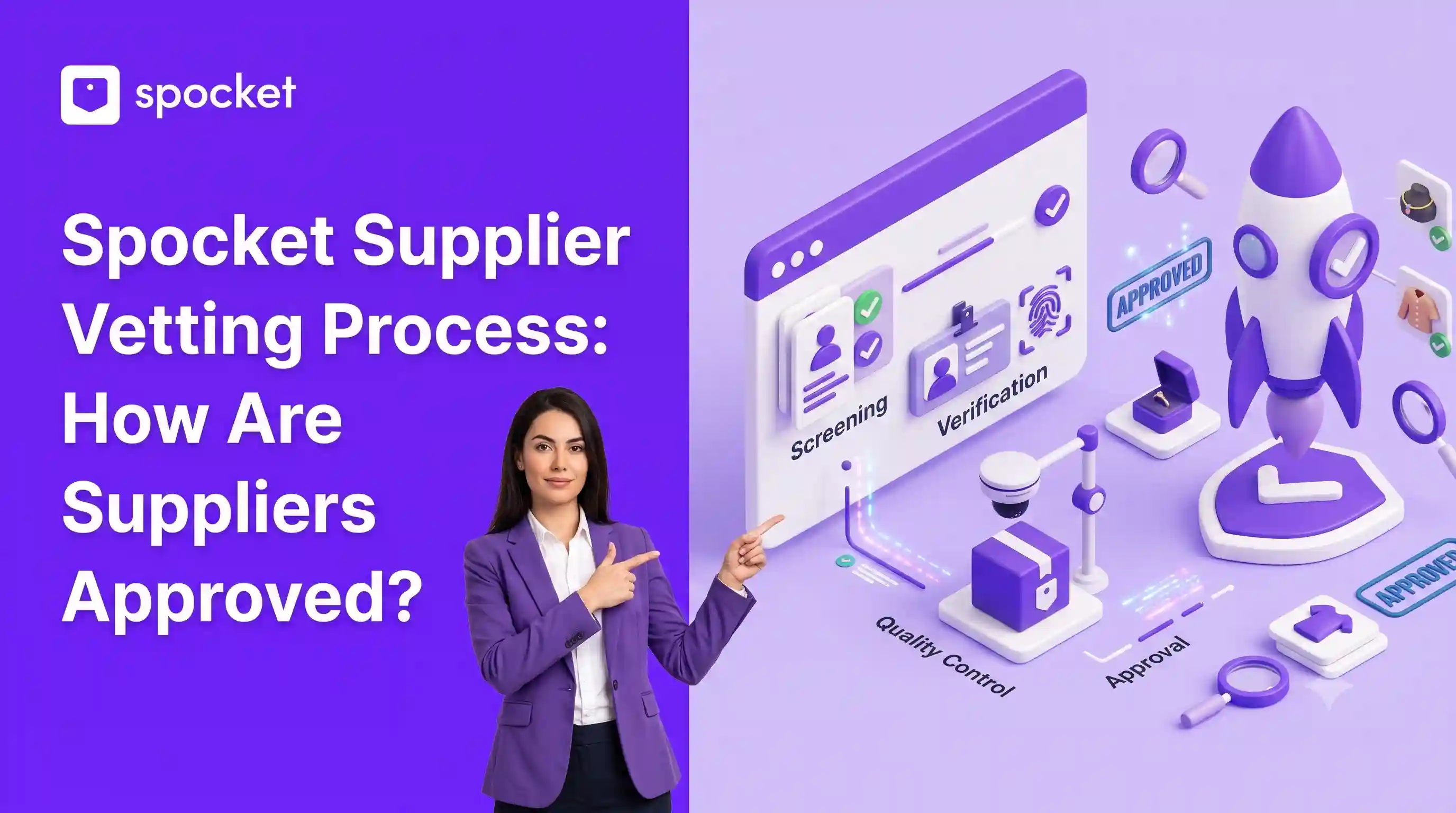
Spocket's supplier vetting process exists to remove that gamble. The platform doesn't just let anyone with inventory sign up and start listing. Suppliers go through a multi-stage screening before their products ever appear in your catalog. This post breaks down exactly how that process works, what criteria suppliers have to meet, and what it means for your store's operations day to day.
Why Spocket Supplier Vetting Matters for Dropshippers?
In an unvetted marketplace, you're the quality control department. You have to order samples of every product before listing. You have to test every supplier's shipping speed and communication. You have to handle the refunds when a supplier sends something defective. That's time you could spend on marketing, product research, or just about anything else.
Spocket's vetting process shifts that burden to the platform. By the time a product appears in your catalog, the supplier has already been checked for product quality, shipping reliability, inventory accuracy, and communication responsiveness. You still have to do your own due diligence—ordering samples and testing products yourself—but the floor is much higher than an open marketplace.
The result is fewer refunds, fewer customer service headaches, and a store that builds a reputation for reliability rather than one constantly putting out fires. When you browse trending dropshipping products on Spocket, you're seeing items from suppliers who have already been screened.
How the Spocket Supplier Vetting Process Works?
The vetting process isn't a single checkbox. It's a sequence of evaluations that test different aspects of a supplier's operation. Not every supplier who applies gets approved. Those who do have demonstrated they can meet the standards required to fulfill orders for US and EU customers.
1. Initial Application and Business Verification
Every supplier starts by submitting an application. Spocket reviews basic business information: where the supplier is located, what products they manufacture or distribute, how long they've been in operation, and whether they have experience with dropshipping fulfillment. This initial filter removes businesses that clearly aren't a fit.
The platform verifies that the supplier is a legitimate business entity. This isn't a deep financial audit, but it does screen out the kind of fly-by-night operations that populate unvetted marketplaces. Suppliers have to show they have a real warehouse or fulfillment center, not just a virtual office address.
If you've ever sourced from AliExpress, you know the gamble. A supplier might have a polished storefront and five-star reviews that turn out to be fake. Spocket's initial verification step eliminates that uncertainty by checking the basics before the supplier even reaches the product review stage.
2. Product Quality Inspection
Once a supplier passes the business verification, Spocket evaluates their products. This isn't done through catalog photos and descriptions. The platform orders physical samples. Real products are shipped to Spocket's team for hands-on inspection.
The inspection checks several things. Does the product match the supplier's description and photos? Is the material quality what was promised? Are there obvious defects in stitching, printing, or assembly? Does the packaging protect the product during shipping? Would a customer who received this be satisfied or disappointed?
Suppliers whose samples don't meet quality standards are rejected or asked to improve before being listed. Those who pass demonstrate that what they show in their catalog is what customers will actually receive. For a dropshipper, that's the difference between a five-star review and a refund request.
3. Shipping Speed and Reliability Testing
Product quality matters, but so does delivery speed. Spocket tests how quickly suppliers can fulfill and ship orders. This is especially important for the platform's US and EU suppliers, who are expected to deliver within a few business days.
The testing process looks at order processing time: how long from when an order is placed until the supplier marks it as shipped. It checks the carrier used and whether tracking information is accurate and updates promptly. It measures the actual transit time to different regions within the US and EU. Suppliers who consistently hit delivery windows are prioritized. Those who don't are either rejected or, if the issue is correctable, given feedback and a chance to improve.
This step is why Spocket can confidently display shipping estimates on product pages. The estimates aren't based on what the supplier claims. They're based on what the vetting process observed. When you see "Ships in 2-5 days" on a Spocket product, that number comes from real testing, not a supplier's optimistic guess.
4. Inventory Management and Accuracy
Selling a product that's out of stock is one of the fastest ways to frustrate a customer. Spocket checks that suppliers can maintain accurate inventory data and update it in real time. A supplier whose stock levels are consistently inaccurate won't make it through.
The platform also evaluates whether the supplier can handle order volume. A supplier who can fulfill 10 orders a week might crumble at fifty. Spocket looks at the supplier's fulfillment capacity, their warehouse size, their staffing, and whether they have systems in place to scale. This protects dropshippers from the nightmare of a product going viral and the supplier being unable to keep up.
Because Spocket has no MOQs, you're not locked into bulk orders. You can test a product with one order, see how the supplier performs, and scale up when you're confident. That flexibility matters, but it only works if the supplier can actually handle the volume when you do scale. The vetting process checks for that.
5. Communication and Responsiveness
When something goes wrong with an order—and in ecommerce, something always eventually goes wrong—you need a supplier who responds quickly and resolves issues professionally. Spocket evaluates supplier communication during the vetting process.
The team sends inquiries, asks questions about products, and simulates problem scenarios to see how the supplier handles them. Do they respond within a reasonable time? Do their answers actually address the issue? Are they professional in tone and cooperative in approach? A supplier who ignores messages or gives vague, unhelpful responses won't pass this stage.
This matters more than most dropshippers realize. When a customer emails you about a damaged product, you're the one who has to get answers from the supplier. If the supplier takes three days to reply, you're the one who looks bad to the customer. Spocket's communication screening ensures that when you reach out to a supplier, you're not shouting into the void.
Start your dropshipping business today
Try Spocket Free!
6. Ongoing Monitoring After Approval
Getting approved isn't a permanent status. Spocket continues to monitor supplier performance after they're listed in the catalog. Key metrics like order defect rate, shipping time, inventory accuracy, and customer feedback are tracked over time. If a supplier's performance starts to slip, they may receive warnings, have their product visibility reduced, or be removed from the platform entirely.
This ongoing monitoring protects dropshippers from the gradual quality decline that can happen with any supplier. A supplier who was great six months ago might cut corners today. Spocket's system catches that pattern and takes action before it affects hundreds of your orders.
The platform also handles supplier quality based on reviews and feedback from dropshippers. If a store owner reports consistent issues with a supplier, that feedback feeds into the monitoring system. You're not alone in evaluating supplier performance. The entire network contributes to keeping quality high.
What the Vetting Process Means for Your Store?
The vetting process directly impacts the metrics that matter to your bottom line.
First, refund rates drop. When products match their descriptions and arrive undamaged and on time, customers don't ask for their money back. The refund rate on Spocket products is consistently lower than what's typical for unvetted marketplaces. Every refund you don't issue is profit you keep and a customer you retain.
Second, shipping speed becomes a competitive advantage. While competitors are promising delivery in two to three weeks and hoping for the best, your Spocket-sourced products arrive in days. That speed shows up in your reviews, your repeat purchase rate, and your conversion rate when customers see "Fast Shipping" badges on your product pages.
Third, customer service workload decreases. Fewer complaints about slow shipping. Fewer angry emails about product quality. Fewer chargebacks to fight. You spend less time putting out fires and more time growing your store.
Fourth, your brand reputation improves. Every positive review, every repeat purchase, every customer who tells a friend builds a brand that people trust. That trust is impossible to build on a foundation of unreliable suppliers. Spocket's vetting provides that foundation.
If you're currently sourcing from unvetted suppliers and dealing with the consequences, the switch to a vetted network pays for itself in reduced refunds and fewer support headaches. Use the profit margin calculator to compare your current refund-adjusted margins against what you could achieve with a lower refund rate. The math often points toward a premium on reliable supply.
Why Some Suppliers Don't Make the Cut?
Not every supplier who applies gets approved. Spocket rejects suppliers for a range of reasons, and understanding those reasons helps you appreciate what the vetting process is actually filtering out:
- Product quality is the most common rejection. A supplier's sample might look fine in photos but feel cheap in person. Fabric might pill after one wash. Electronics might fail basic functionality tests. If the product doesn't meet the standard, the supplier doesn't get listed.
- Shipping inconsistency is another major filter. A supplier who can ship quickly sometimes but not reliably isn't dependable enough for a store that makes delivery promises to customers. Spocket looks for consistency, not just speed.
- Poor communication gets suppliers rejected too. If the vetting team can't get clear, timely answers during the evaluation phase, dropshippers won't get them either when real problems arise.
- Inventory management problems also block approval. A supplier who can't accurately report stock levels or who oversells their inventory creates problems that cascade through the entire order chain.
And some suppliers simply don't fit the platform's geographic focus. Spocket prioritizes suppliers with inventory in the US and EU because those locations enable the fast shipping speeds that the platform is known for. A supplier who ships exclusively from overseas might be perfectly good but doesn't align with what Spocket's customers need.
How Spocket Integrates with Your Existing Workflow?
Once suppliers are vetted and their products are in the catalog, the platform makes it easy to get those products into your store. Spocket integrates with Shopify, Wix, WooCommerce, eBay, and BigCommerce. You can import products with one click, customize titles and descriptions, and push them live in minutes.
Automated inventory syncing means you never accidentally sell a product that's out of stock. When a supplier's inventory changes, your store updates automatically. Order forwarding sends customer details to the supplier without you manually entering anything. Tracking information syncs back to your store so customers can follow their package from warehouse to doorstep.
Branded invoicing, available on higher-tier plans, puts your store name and logo on packing slips instead of the supplier's. That small touch reinforces the brand you're building and keeps the supplier invisible to the customer.
The integration layer means you can focus on marketing and product curation while the platform handles the operational heavy lifting. The vetting process ensures that the products flowing through that pipeline are ones you can stand behind.
Conclusion
Spocket's supplier vetting process is the reason the platform can promise what most dropshipping marketplaces can't: consistent product quality, fast and reliable shipping, and suppliers who communicate like professionals. The multi-stage screening—business verification, product inspection, shipping testing, inventory accuracy checks, communication evaluation, and ongoing monitoring—filters out the unreliable suppliers that make dropshipping a headache on open marketplaces.
For a dropshipper, that means fewer refunds, fewer support tickets, and a store that customers trust enough to buy from again. The platform doesn't eliminate the need for your own due diligence, but it raises the floor so high that most of the worst-case scenarios simply never happen.
If you're ready to build a store on a foundation of vetted suppliers, start your free trial with Spocket and browse the catalog of products that have already passed the test.
Spocket Supplier Vetting Process FAQs
How long does the Spocket supplier vetting process take?
The timeline varies by supplier, but most approvals take several weeks from application to listing. The process involves physical product sampling, shipping tests, and communication evaluations, all of which require real time to complete properly.
Does Spocket vetting guarantee I'll never have a bad order?
No vetting process can guarantee zero issues. Products can still get damaged in transit, and occasional supplier mistakes happen. But the vetting process dramatically reduces the frequency of these problems compared to unvetted marketplaces.
Can I suggest a supplier to Spocket for vetting?
Yes. If you have a relationship with a supplier you'd like to see on the platform, you can contact Spocket's support team with their information. The supplier will still need to pass the full vetting process before being listed.
How often are suppliers re-evaluated after approval?
Spocket monitors supplier performance on an ongoing basis. Key metrics like defect rate, shipping time, and inventory accuracy are tracked continuously. Suppliers who fall below standards may be warned, have visibility reduced, or be removed.
Does Spocket vetting include ethical and sustainability checks?
Spocket's primary vetting criteria focus on product quality, shipping reliability, inventory accuracy, and communication. If ethical sourcing or sustainability certifications are important to your brand, you should verify those directly with the supplier before listing their products.
Can a supplier be removed from Spocket after being approved?
Yes. If ongoing monitoring reveals a decline in performance—slower shipping, more defects, inventory problems—the supplier can be removed from the platform. This keeps the catalog quality high over time rather than letting it degrade as suppliers cut corners.


Launch your dropshipping business now!
Start free trial.avif)


Related blogs
Dropshipping Supplier Directory: Where to Find Vetted Suppliers
Browse our directory of vetted dropshipping suppliers across the US and EU, complete with niches, shipping speed, and pricing. Start your free trial today.

How to Negotiate With Dropshipping Suppliers: 9 Tactics That Actually Work
Learn how to negotiate with dropshipping suppliers on price, MOQs, and payment terms. Proven tactics and email scripts to boost your margins. Try Spocket free.

Best Clothing Dropshipping Suppliers: The 2026 Guide
Compare the best clothing dropshipping suppliers for 2026 — US/EU shipping speeds, pricing, and product quality — and find the right fit to launch your store.