SPOD Review 2026: Is It a Good Print on Demand Dropshipping Option?
An honest SPOD review covering delivery timelines, embroidery options, shipping fees, and integrations. Learn what SPOD gets right and where it falls short.

You sell custom merch online. An order comes in. Now you wait, hoping your print provider ships it before the customer gets restless. That wait, and the refund requests that follow slow fulfillment, can unravel a store faster than almost anything else.
Speed sits at the center of the SPOD (Spreadshirt Print‑on‑Demand) promise. The platform claims a 48‑hour production window on 95% of orders, which puts it ahead of most competitors on turnaround time. But speed alone does not make a print‑on‑demand partner the right fit for your business. You need to know how the product catalog stacks up, what the real shipping costs look like, how refunds get handled, and whether the integration options match where you sell.
This SPOD review walks through every layer that matters when you choose a print provider: the feature set, the pricing model, the product range (including SPOD embroidery options), delivery timelines, refund terms, and how the platform holds up when you compare it side by side with alternatives like Spocket. By the end, you will know whether SPOD fits your store or whether you should look elsewhere.
What Is SPOD?
SPOD is a print‑on‑demand fulfillment service built by Spreadshirt, a company with more than 20 years in the custom apparel business. The platform lets you upload your designs, place them on blank products from the catalog, and sell through your own online store. When a customer buys, SPOD prints and ships the item directly to them. You never hold inventory, and you pay only when a sale happens.
The service runs its own production facilities in the United States and Europe. Factories in Henderson, Nevada and Greensburg, Pennsylvania handle US orders, while European production happens in Leipzig, Germany, Krupka in the Czech Republic, and Legnica, Poland. Because SPOD owns the production line instead of routing work to third parties, it keeps tighter control over quality and turnaround times. That matters when your customer expects a shirt or hoodie to arrive within a predictable window.
How Does SPOD Work?
SPOD plugs into your e‑commerce store and automates the fulfillment chain. After you install the app, you pick items from the catalog, upload artwork, and create product listings. When a customer places an order, SPOD receives the details, prints the design on the chosen product, packages it, and ships it under your store name.
The workflow removes every physical touchpoint on your end. You handle design, marketing, and customer communication. SPOD handles production, packing, and carrier handoff. The integration pulls order data automatically, so you do not manually forward anything once the setup is complete.
That automation cuts out a common point of failure in SPOD dropshipping: missed orders or data entry mistakes that happen when someone has to relay information between systems by hand. For store owners running lean operations, that reliability can free up hours each week.
Key Features of SPOD
.webp)
Here are the key features of SPOD dropshipping:
- 48‑hour production guarantee: 95% of orders ship within two business days. Half leave the facility inside 24 hours. That speed gives you room to offer shorter delivery promises on your storefront.
- 50,000‑asset design library: If you do not have your own artwork ready, you can pull from a large collection of free graphics, shapes, icons, and backgrounds directly inside the SPOD product builder.
- 200‑plus product catalog: The selection covers apparel, drinkware, wall art, bags, and accessories. The range is smaller than some competitors, but it includes the highest‑volume categories most merch stores rely on.
- Embroidery support: SPOD offers embroidery on hats, polos, bags, and select garments, giving you a way to sell higher‑perceived‑value products without changing platforms.
- Multiple print methods: The platform uses digital direct, thermal sublimation, DTF transfer, and flex/flock printing. Each method suits different product types, from photo‑quality mugs to single‑color logos on tees.
- Sample order discount: You get 20% off sample orders, which makes it cheaper to check print quality and fit before listing a product publicly.
- Sustainability focus: SPOD runs centralized in‑house production, which reduces waste compared to distributed supplier models. Products are made only after a sale, so there is no excess stock to landfill.
- White‑label packaging: Items ship in unbranded mailers, boxes, and packing tubes. Your customer sees your store identity, not a third‑party logo.
SPOD Pricing: Only Pay When You Sell
SPOD pricing follows a straightforward pay‑per‑order model. Installing the app costs nothing. There is no monthly subscription and no setup fee. You pay only when an order comes through your store. That keeps your fixed overhead at zero, which helps if you are testing a new niche or running a seasonal merch campaign.
Here is how the costs break down for popular items based on current pricing:
- T‑shirt (Gildan 64000): roughly $7.79 base cost
- Hoodie: roughly $18.00 base cost
- Mug: roughly $6.99 base cost
- Domestic US shipping: starts at $3.57
The base cost covers the blank product, the print, and standard packaging. You set the retail price above that base and keep the difference. SPOD bills you for the base cost plus shipping after the order ships, not before.
Shipping fees vary by order value, destination, and carrier type. SPOD’s shipping calculator, available inside the app and in the help center, lets you check exact rates before you set your retail prices. If you misjudge the shipping cost, you can eat into your margin on a sale, so checking those figures before listing products matters.
There are no hidden platform fees on the SPOD side. However, your e‑commerce platform (Shopify, WooCommerce, or whichever you use) will charge its own transaction and subscription fees. Those are separate from anything SPOD bills.
SPOD vs Other Print‑on‑Demand Alternatives
No single print provider fits every store. Your choice depends on which trade‑offs you accept. Some platforms win on product variety, others on branding features, and others on international shipping simplicity. Here is where SPOD stands relative to the field.
Where SPOD leads:
- Production speed: 48‑hour guarantee, with half of orders shipping within 24 hours. Printful averages 2–5 business days. Printify timelines range from 2–7 business days depending on the supplier you pick.
- Free design assets: SPOD’s library holds roughly 50,000 graphics. Printful limits free users to about 25,000.
- File format flexibility: SPOD accepts JPEG, PNG, Adobe Illustrator, and CDR vector files. Printful supports JPEG and PNG but not AI or CDR formats.
- Phone support: SPOD offers phone support, a rarity among POD platforms. Most competitors restrict you to email or live chat.
- Base product cost: SPOD’s per‑unit pricing lands lower than Printful on many core items. A basic tee runs about $7.79 on SPOD compared to $10–15 on Printful.
Where SPOD falls short:
- Product catalog size: SPOD offers around 200–250 products. Printful has 330‑plus. Printify connects you to 850‑plus through its marketplace of print providers.
- Branding options: SPOD uses white‑label packaging but does not let you add branded inserts, custom inside labels, or branded mailers. Printful allows inside and outside label branding, custom pack‑ins, and branded packaging for a fee.
- Platform integrations: SPOD integrates natively with Shopify and WooCommerce. Access to Amazon, eBay, Etsy, and Squarespace requires the third‑party tool Order Desk, which adds cost and setup time. Printful offers 23 direct integrations.
- International selling setup: SPOD asks you to choose a production region (US or EU) at account setup. Shipping outside your chosen region is limited. If you need to serve both US and EU customers, you may need two separate SPOD accounts. Printful automatically routes international orders to the nearest facility.
- User review variance: The Shopify App Store currently shows a 3.6 rating with 125 reviews for the app (now listed under Spreadconnect). That is down from the 4.1 rating it held previously. Meanwhile, the TrustPilot page carries a 2.6 average across 7 reviews, with complaints centered on account verification issues and backend limitations.
SPOD vs Spocket: What are their Differences?
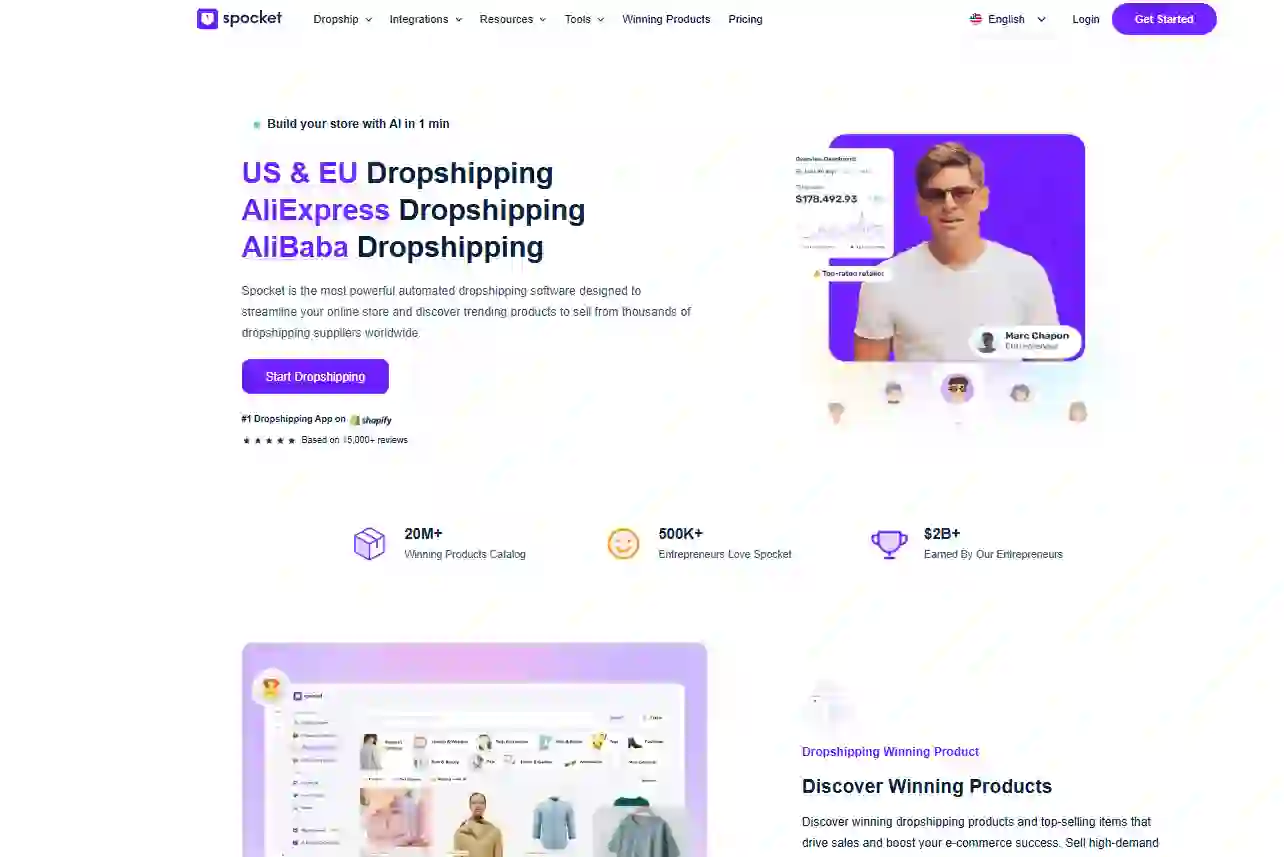
SPOD and Spocket serve different dropshipping needs, and putting them next to each other makes the distinction clear.
SPOD is a pure Print‑on‑demand service. You design graphics, apply them to blank goods, and sell custom merchandise. Every product gets printed after a customer orders it. That model fits merch stores, creator brands, and anyone who wants to sell original designs on apparel or accessories.
Spocket works as a general dropshipping marketplace. It connects you with suppliers, mainly in the US and Europe, who stock finished goods across dozens of categories: fashion, electronics, home decor, beauty, and pet supplies. You pick products that are already made, list them, and Spocket routes orders to the supplier who ships to your customer. You do not create any designs.
The operational differences matter for your margins and daily workflow. Spocket has no MOQs, so you can list products without committing to bulk purchases, and because many suppliers are US‑ or EU‑based, shipping times often run 2–7 days. SPOD’s production adds a 48‑hour window on top of carrier transit time, but you control the product’s look entirely.
On integrations, Spocket covers more store platforms. Spocket integrates with Wix, WooCommerce, eBay, and BigCommerce, alongside Shopify. SPOD’s native integrations are narrower, covering Shopify and WooCommerce directly, with other platforms available through Order Desk.
If you sell original merch, SPOD aligns with that model. If you want to sell existing products across multiple categories without designing anything, Spocket’s supplier network gives you a broader starting point. Many store owners use both: SPOD for custom branded apparel and Spocket for complementary trending dropshipping products like tech accessories or home and garden goods that round out the catalog.
How to Get Started with SPOD Dropshipping?
Setting up SPOD takes less than an hour for a basic store. You will spend more time preparing your designs and checking sample quality than on the technical setup itself.
1. Create Your Shopify or WooCommerce Store
SPOD works natively with Shopify and WooCommerce. If you do not have a store yet, pick one and complete the basic configuration: domain, payment gateway, shipping settings, and store policies. Shopify tends to be the smoother path because the SPOD app is built specifically for its ecosystem.
2. Install the SPOD App
From your Shopify admin, go to the App Store, search for SPOD (now listed as Spreadconnect: Print on Demand), and click install. The app will ask you to create an SPOD account or log in. During account setup, you will choose your primary production region: US or Europe. Pick the one closest to your target customers. That choice affects shipping speeds and which products are available.
3. Design Your First Product
Open the product builder inside the SPOD dashboard. Browse the catalog and pick an item: a t‑shirt, hoodie, mug, or tote bag. Upload your artwork in JPEG, PNG, AI, or CDR format. Use the design tool to position, scale, and preview your graphic on the product. If you are starting without original artwork, pull from the 50,000‑asset design library.
The builder lets you add text, adjust colors, and see a realistic mockup of the finished product. You can also set up SPOD embroidery designs on compatible items like hats, polos, and bags using the same interface.
4. Publish and Set Your Prices
Once the design looks right, push the product to your store. SPOD creates the listing with placeholder pricing. Go into your Shopify or WooCommerce product editor and set the retail price based on the SPOD base cost plus shipping. Remember to account for your platform’s transaction fees and any ad spend you plan to allocate.
5. Order a Sample
Before you drive traffic, order a sample of each product. SPOD gives you 20% off sample orders. Check the print quality, fabric feel, sizing accuracy, and packaging. If something looks off, adjust your design or pick a different blank product. Fixing issues at this stage prevents customer complaints later.
Top SPOD Dropshipping Products
Not every item in the catalog sells equally well. Based on what high‑volume merch stores run, these categories perform consistently:
- Unisex t‑shirts (Gildan 64000, Bella‑Canvas 3001): The highest‑volume category. Low base cost, broad appeal, and easy to design around. These are the backbone of most SPOD stores.
- Hoodies and crewneck sweatshirts: Higher AOV items. Base costs run higher, but you can price them at $35–55 and still convert customers who already trust your brand.
- Mugs: Sublimation printing produces vibrant, photo‑quality results. Mugs make good upsells and gift items, especially during Q4.
- Embroidered hats and polos: SPOD embroidery adds perceived value. A dad hat with a clean embroidered logo can sell for $25–30 on a base cost that leaves healthy margin.
- Tote bags: Low production cost, easy to design, and popular with niche audiences like book clubs, eco‑conscious shoppers, and event merch.
- Posters and wall art: Digital direct printing handles detailed artwork well. These items let you sell to fans who want something beyond apparel.
SPOD products cover additional categories like phone cases, tank tops, and baby onesies. The catalog may not have the breadth of Printify’s 850‑plus SKU list, but it hits the core items that drive most POD revenue.
Is SPOD Legit and Safe to Use?
Yes, SPOD is a legitimate print‑on‑demand service backed by Spreadshirt, a company that has operated in the custom apparel industry for over 20 years. The platform fulfills thousands of orders daily through its own factories in the US and Europe. Real brands, including official artist merch stores, run on it.
That said, is SPOD trustworthy for your specific needs? The answer depends on what you prioritize.
SPOD’s production speed and base pricing are real. The 48‑hour turnaround is not marketing copy; it is the standard that 95% of orders meet. The pay‑per‑order model means you risk nothing on unsold stock. And the in‑house production setup gives you more consistency than marketplace models where quality varies by print provider.
The areas where trust erodes, based on user reviews, involve account verification, payment processing, and backend reliability. Some users report that their accounts got stuck in verification limbo, preventing orders from entering production. Others describe credit card rejection issues where the SPOD system would not accept valid payment methods. The TrustPilot page carries a 2.6 rating, with the most visible complaints tied to these operational friction points.
You can explore the platform on the official SPOD site. For a broader view of user sentiment, the SPOD Capterra review page and the SPOD TrustPilot page both show how merchants rate the service after months or years of use.
If you plan to use SPOD, complete the account verification step before listing products. Place a sample order early. Confirm that your payment method processes without errors. These checks take under an hour and can surface problems while you still have time to pivot.
SPOD Payment Gateways and Billing
SPOD does not process payments from your customers. That happens on your store platform through whatever gateway you set up: Shopify Payments, PayPal, Stripe, or others. SPOD bills you separately for the base product cost and shipping each time an order ships. You need a valid credit or debit card on file in your SPOD account to cover those charges.
Some users have reported issues where the SPOD system declines multiple credit cards, including Visa, Mastercard, and PayPal-backed cards. These incidents appear in user reviews and seem to correlate with account verification problems. If you run into this, contact SPOD support before assuming your card is at fault. In several cases, the root issue was an incomplete account verification, not the payment method itself.
You should also know that SPOD bills in USD, regardless of where your store is based. If you sell in a different currency, factor in conversion fees from your card issuer.
SPOD Shipping Timelines, Refunds, and Fees
SPOD delivery timelines break into two parts: production and carrier transit. Production runs within 48 hours for 95% of orders. Half of all orders leave the facility within 24 hours. After handoff to the carrier, domestic US shipments typically arrive in 3–8 business days. European shipments follow similar windows within the EU.
Total delivery time from order to doorstep averages around 5–10 business days for domestic routes. International shipments outside your chosen production region take longer and cost more. SPOD is strongest when you sell primarily to customers in your selected production zone.
SPOD shipping fees start at roughly $3.57 for domestic US orders and scale based on the total order value, not the number of items. Heavier products like hoodies cost more to ship than t‑shirts. The shipping calculator inside the app gives exact rates; use it before pricing your products.
The SPOD refund policy covers three specific situations:
- Misprinted products
- Damaged products (excluding carrier‑caused damage during delivery)
- Products that do not match the fulfillment information (wrong size, color, or print placement)
For any of these, you must send a photograph and a description to SPOD support within 30 days of delivery. SPOD decides at its discretion whether to issue a refund, credit, or replacement. If the issue is confirmed, SPOD refunds the product cost. You would then place a new order manually if you want to send a replacement to your customer.
SPOD does not refund for:
- Customer change of mind
- Wrong size ordered by the customer
- Late delivery caused by the carrier
- Return‑to‑sender packages
Those situations fall under your store policy. You eat the cost if you choose to refund the customer. Knowing this before you write your store return policy helps you set customer expectations accurately.
SPOD Print‑on‑Demand Integrations
SPOD Print‑on‑demand works natively with Shopify and WooCommerce. The Shopify integration is the most polished path, with the app living inside the Shopify admin and syncing products, orders, and tracking data automatically.
For other platforms, SPOD connects through Order Desk, a third‑party order management middleware. That opens up Amazon, eBay, Etsy, and Squarespace, but it adds a monthly Order Desk subscription fee and configuration work. If you sell across multiple marketplaces, that extra layer may be worth the setup time. If you only run a Shopify store, you will never need to touch Order Desk.
SPOD also offers a public API for custom integrations. If you have developer resources, you can build a direct connection to a custom storefront or a platform not covered by the standard integrations.
Top Dropshipping Niches on SPOD Dropshipping
Some niches align better with SPOD’s strengths than others. If you pick a niche where fast fulfillment and clean basic products matter more than huge product variety, SPOD performs well.
- Music and band merch: Fans want shirts, hoodies, and hats. Speed matters when you are fulfilling tour or album drop orders. SPOD’s 48‑hour turnaround keeps fan excitement from cooling into refund requests.
- Fitness and gym brands: Motivational quote tees, tank tops, and embroidered caps fit the catalog well. The Gildan and Bella‑Canvas blanks are gym‑tested.
- Corporate and event swag: When a company needs branded polos, mugs, and tote bags for an event, SPOD’s consistent quality and fast production prevent last‑minute disasters.
- Niche hobby communities: Knitting, gaming, gardening, dog breeds. Small passionate audiences buy merch that represents their identity. You can test designs with zero inventory risk.
- Custom pet portraits on demand: Combine custom print‑on‑demand with a service where customers upload pet photos. SPOD’s sublimation and digital printing handle photo‑quality output on mugs, posters, and shirts.
A note on what to avoid: SPOD’s catalog does not cover specialized items like all‑over‑print leggings, custom sneakers, or cut‑and‑sew pieces. If your niche depends on those products, Printify’s larger supplier network will serve you better.
Conclusion
SPOD earns its place by doing one thing well: printing and shipping basic custom merch faster than most competitors. You get a 48‑hour production window, in‑house quality control, and a pay‑per‑order pricing model that keeps startup risk low. The trade‑offs include a smaller catalog, limited branding options, and a narrower list of native integrations. Those limitations matter more if you sell across multiple channels or want premium unboxing touches. If speed and simplicity anchor your operation, SPOD can handle fulfillment reliably. If you need catalog depth or marketplace reach, pairing SPOD with a broader supplier network gives you the best of both approaches without overhauling your store.
Start your dropshipping business today
SPOD Dropshipping 2026 FAQs
What is SPOD and who runs it?
SPOD stands for Spreadshirt Print‑on‑Demand, a service owned by Spreadshirt, a company with over 20 years of experience in custom apparel production. The platform lets you upload designs, apply them to blank products, and sell through your online store while SPOD handles printing and shipping.
Is SPOD really free to use?
Yes. SPOD charges no installation fee and no monthly subscription. You pay only when an order ships, covering the base product cost and shipping fee. Your e‑commerce platform may charge its own subscription and transaction fees separately.
How fast does SPOD ship orders?
SPOD produces and ships 95% of orders within 48 hours. Half of all orders leave the facility within 24 hours. After carrier handoff, domestic deliveries typically take 3–8 business days depending on the destination.
Does SPOD offer embroidery?
Yes. SPOD supports embroidery on hats, polos, bags, and select garments. You can set up embroidered products through the same product builder used for printed items.
What is SPOD’s refund policy?
SPOD offers refunds, credits, or replacements for misprinted items, damaged products, or orders that do not match the fulfillment information provided. You must submit a photo and description within 30 days of delivery. Returns for customer preference reasons are not covered.
Can I use SPOD on platforms other than Shopify?
Yes. SPOD integrates natively with Shopify and WooCommerce. It also connects to Amazon, eBay, Etsy, and Squarespace through Order Desk, a third‑party order management tool. A public API is available for custom integrations.
How does SPOD compare to Spocket?
SPOD focuses on custom print‑on‑demand merchandise where you supply the designs. Spocket is a general dropshipping marketplace with ready‑made products across multiple categories. Many sellers use both: SPOD for branded apparel and Spocket for complementary non‑custom items.
Is SPOD safe to use as a dropshipping supplier?
SPOD is a legitimate service backed by Spreadshirt’s two‑decade track record. Most users report fast fulfillment and acceptable print quality. Some have encountered account verification or payment processing issues, so completing verification and ordering a sample before launching is advisable.


Launch your dropshipping business now!
Start free trial.avif)


Related blogs
Dropshipping Supplier Directory: Where to Find Vetted Suppliers
Browse our directory of vetted dropshipping suppliers across the US and EU, complete with niches, shipping speed, and pricing. Start your free trial today.

How to Negotiate With Dropshipping Suppliers: 9 Tactics That Actually Work
Learn how to negotiate with dropshipping suppliers on price, MOQs, and payment terms. Proven tactics and email scripts to boost your margins. Try Spocket free.

Best Clothing Dropshipping Suppliers: The 2026 Guide
Compare the best clothing dropshipping suppliers for 2026 — US/EU shipping speeds, pricing, and product quality — and find the right fit to launch your store.