Why is My Shopify Store Getting Traffic but No Sales?
Getting traffic but no Shopify sales? Discover why your Shopify store isn’t converting and learn proven strategies to increase sales fast.
.avif)

If your Shopify store is getting visitors but your Shopify sales aren’t moving, you’re not alone—and it’s rarely “bad luck.” Most of the time, the problem is a conversion gap: the right people aren’t landing on your store, or the right people are landing—but something is stopping them from buying. It could be mismatched traffic, weak product pages, pricing friction, lack of trust signals, or a checkout experience that leaks customers at the last second. The good news is you don’t need more traffic to fix this—you need a clearer diagnosis and a few high-impact changes that turn clicks into customers. In this guide, you’ll learn the most common reasons stores get traffic but no sales, plus practical fixes to increase Shopify sales quickly.
Why You’re Getting Traffic But No Shopify Sales
Getting traffic feels exciting. You refresh Shopify analytics and see visitors coming in. But then you check revenue… and it’s zero.
Here’s the truth: traffic does not equal Shopify sales. Sales happen when the right people land on the right offer at the right time — and nothing blocks them from buying. If you’re getting traffic but no conversions, there’s usually a quality issue, a targeting problem, or a conversion gap inside your store.
Let’s break it down clearly.
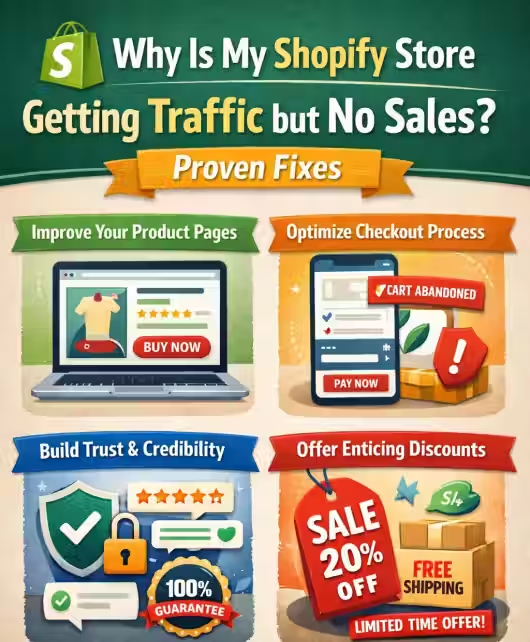
Traffic Quality vs Traffic Quantity
More visitors won’t fix your problem if they’re not buyers.
Are visitors buyers or just browsers?
If most of your traffic comes from a viral TikTok like “Amazon finds under $20,” those visitors are browsing for entertainment. They are not actively looking to purchase a specific product from your brand.
Check:
- Bounce rate (over 70% = weak intent)
- Time on page (under 30 seconds = low engagement)
- Add-to-cart rate (under 3% = poor buying interest)
If people land and leave quickly, they’re not aligned with your offer.
Paid ads bringing the wrong audience
Many stores run Facebook ads or TikTok ads targeting broad interests like “Shopping” or “Fashion.” That brings cheap clicks — not serious buyers.
Example: If you sell posture correctors but target “Gym” and “Fitness Motivation,” you attract people watching workout videos, not people actively searching for back pain relief.
Fix it:
- Target problem-based audiences (back pain relief, office ergonomics, remote workers)
- Optimize ads for “Purchase,” not “Traffic”
- Use creatives that mention price, shipping time, and outcome
Keyword intent mismatch
SEO traffic can also mislead you.
“Best standing desk” brings researchers.
“Buy standing desk under $200” brings buyers.
If you rank for informational keywords but don’t guide readers toward products, you’ll get traffic but no Shopify sales.
Fix it:
- Add strong CTAs in blog posts
- Create bottom-funnel pages like:
- “Best Standing Desk Under $200”
- “Standing Desk With Fast US Shipping”
Social traffic vs purchase intent
Instagram and TikTok traffic often spikes from aesthetic or entertaining content.
Example: A “Kitchen restock” Reel may send 2,000 visitors — but those viewers may just want inspiration.
Fix it:
- Send traffic to a focused landing page
- Show benefits immediately:
- “Keeps food fresh for 30 days”
- “Ships in 2–5 days”
- “4.7★ from 1,200 customers”
Clarity converts.
You’re Attracting the Wrong Stage of Buyer
Even relevant traffic won’t convert if visitors aren’t ready to buy.
Cold vs warm traffic
Cold traffic:
- “Is this store legit?”
- “Why should I trust this?”
Warm traffic:
- “Is there a discount?”
- “How fast is shipping?”
If you treat cold visitors like warm buyers, conversions drop.
Fix it: For cold traffic, show:
- 30-day returns
- Clear shipping time
- Real reviews
- Secure checkout badges
For warm traffic, offer:
- Bundle deals
- Free shipping threshold
- Limited-time discounts
Awareness vs purchase stage
Awareness search: “Why does my neck hurt when working?”
Purchase search: “Best ergonomic neck pillow for office chair”
If you’re attracting awareness-stage visitors, you must educate first and sell second.
Fix it:
- Offer a discount code in exchange for email
- Use retargeting ads for visitors who viewed products
- Add comparison sections on product pages
Missing retargeting strategy
Most customers don’t buy on the first visit. If you don’t retarget, you lose them permanently.
Simple retargeting structure:
- 1–7 days after visit → show testimonials
- 1–14 days after cart → offer free shipping or small discount
- Email flows → abandoned checkout + browse reminders
Retargeting alone can double Shopify sales without increasing traffic.
Conversion Rate Problems That Kill Shopify Sales
The average Shopify conversion rate is between 1% and 3%. If yours is below 1%, you likely have friction inside your store.
Conversions fail when:
- The product lacks demand
- The page lacks persuasion
- The pricing lacks strategy
- The store lacks trust
Let’s fix each one.
Weak Product-Market Fit
If people don’t truly want your product, no amount of traffic will help.
No real demand
Some products go viral but lack consistent demand. A “LED moon lamp” may get clicks but not steady purchases.
Before scaling ads, validate demand:
- Are competitors running ads for months?
- Are there consistent searches like “best portable blender for smoothies”?
If demand is unstable, your Shopify sales will be unpredictable.
Saturated product
If you sell a generic waist trainer or phone case that 100 stores already sell, you compete on price.
Instead of selling: “Waist trainer”
Sell: “Postpartum waist support belt for new moms”
Niche positioning increases conversion rates.
No unique value proposition
If customers can’t answer “Why buy from you?” they won’t buy.
Example: Selling a stainless steel water bottle? Why not Amazon?
You need:
- Faster shipping
- Better materials
- Extra lids included
- Warranty
- Clear benefits
Specific beats generic.
Poor Product Pages
Your product page is the most important part of your store. If it fails, traffic won’t matter.
No emotional trigger
People buy outcomes.
Don’t write: “Memory foam pillow.”
Write: “Wake up without neck stiffness — designed for side sleepers.”
Focus on results, not features.
Weak product descriptions
Bad example:
- Adjustable straps
- Breathable fabric
Better example:
- Adjust in 10 seconds for a custom fit
- Lightweight and breathable for all-day wear
Translate features into real-life benefits.
No social proof
No reviews = high risk.
Add:
- Photo reviews
- Star ratings
- Short testimonials
- “Verified buyer” badges
Even 15–20 reviews improve trust dramatically.
Low-quality images
One supplier image won’t convert premium buyers.
Add:
- Lifestyle images
- Close-ups
- Size comparisons
- Short demo videos
High-quality visuals directly impact Shopify sales.
Missing clarity above the fold
Within 5 seconds, customers should see:
- What it does
- Who it’s for
- Shipping time
- Returns policy
- Star rating
If they must scroll to understand value, you lose them.
Supplier quality affects trust
If delivery takes 20–30 days or packaging looks cheap, customers hesitate.
Using Spocket to source higher-quality products — often from US or EU suppliers with faster shipping — improves perceived legitimacy. Faster delivery times and consistent product quality reduce refund rates and increase repeat purchases.
Better suppliers = stronger long-term Shopify sales.
Pricing Strategy Is Wrong
Pricing affects both trust and conversions.
Too expensive without justification
If your phone case is $29.99 and Amazon sells similar ones for $12.99, customers need a reason.
Add:
- Drop-test videos
- Warranty
- Better materials
- Comparison table
Price must match value perception.
Too cheap (low trust)
A $9.99 wireless earbuds listing can look suspicious.
If pricing is too low:
- Improve branding
- Show packaging
- Add guarantee
- Raise perceived value
Cheap doesn’t always convert better.
No anchor pricing
$49 feels random without context.
Instead show:
- “Was $79”
- “Includes 3 attachments + travel case”
- “Save $30 today”
Anchoring increases perceived deal value.
No bundle strategy
Selling one item limits revenue and conversion leverage.
Instead of: 1 skincare tool for $39
Offer: “Glow Kit” for $69 (tool + serum + storage pouch)
Bundles:
- Increase AOV
- Improve perceived value
- Make your offer stronger than competitors
Trust Issues That Stop Customers From Buying
Trust is the #1 reason stores get traffic but fail to turn it into Shopify sales. Most visitors don’t know your brand. So even if they like the product, they’ll hesitate if anything feels unclear, risky, or “too dropship-y.” Your job is to remove doubt fast—before they click away.
No Reviews or Testimonials
People trust people more than they trust product descriptions. When a shopper sees “0 reviews,” their brain instantly asks: “Has anyone actually bought this?” That hesitation kills conversions.
Social proof psychology (what’s happening in the customer’s mind):
- “If others bought it and liked it, it’s probably safe.”
- “If nobody has reviewed it, I might be the one who gets scammed.”
What to do (practical fixes):
- Add review widgets on product pages (star rating should show near the product title).
- Show photo reviews and short text reviews like:
“Arrived in 4 days, quality feels premium.”
“Fits true to size, material is thick.” - Add a small “Verified buyer” label if your review app supports it.
User-generated content (UGC) that actually converts:
UGC doesn’t need to be “influencer-level.” It just needs to feel real.
Good UGC examples:
- A customer wearing your hoodie in daylight.
- A short unboxing clip showing packaging.
- A “before/after” video for skincare or posture products.
- A quick demo like: “Here’s how loud this portable blender is.”
Where to place it:
- Right under the product images
- In the middle of the product description
- Above the “Add to Cart” button on mobile (yes, that high)
Missing Trust Signals
Sometimes your product is fine, your price is fine, but the store feels untrustworthy. That usually happens when basic trust elements are missing.
No secure checkout badges
If your checkout looks unfamiliar or “blank,” people worry about card safety.
Fix:
- Add trusted payment icons (Visa, Mastercard, PayPal, Shop Pay)
- Show “Secure Checkout” near the Add to Cart / Checkout button
- Make sure SSL is enabled (Shopify usually covers this, but design placement matters)
No refund policy
If customers can’t quickly find returns info, they assume returns aren’t allowed.
Fix:
- Add a simple “Returns & Refunds” page
- Summarize it on product pages:
- “30-day returns”
- “Refund processed within 3–5 business days”
- “Contact support for help”
No contact page
A store with no contact options looks risky.
Fix:
- Add a dedicated Contact page
- Display:
- support email
- live chat (even if it’s limited hours)
- business address (or registered address if available)
- Put “Contact” in the footer and header
No About Us story
Shoppers buy from brands, not random storefronts. A missing About Us page makes you look like a temporary store.
Fix: Write a simple, human story:
- Why you started the store
- Who your products are for
- What you stand for (quality, fast shipping, customer care)
Example tone: “We started this store because we were tired of products that look great online but arrive cheaply made. Our goal is simple: quality products, clear shipping timelines, and real support.”
That kind of honesty builds trust—and trust drives Shopify sales.
Slow Shipping or Long Delivery Times
This is one of the biggest conversion killers in dropshipping. If a customer sees “Estimated delivery: 15–25 days,” they often leave—even if they love the product.
The dropshipping trust gap
People associate long shipping with:
- cheap product quality
- no customer support
- hard refunds
- “this might never arrive”
Why US/EU suppliers matter
Fast shipping reduces hesitation because customers feel like they’re buying from a real business, not a random overseas listing.
This is where sourcing matters. Using Spocket can help you find suppliers that offer faster shipping options (often US/EU-based) and more consistent product quality—both of which directly increase conversions.
Clear delivery timelines (what to show)
Don’t hide shipping. Be upfront.
Good examples:
- “Ships in 24–48 hours”
- “Delivery in 3–7 business days”
- “Tracking available in 24 hours”
Also add:
- “Shipping & Delivery” accordion on product pages
- Estimated delivery date at checkout (if possible)
The clearer you are, the fewer carts you lose.
Store Design Mistakes That Reduce Shopify Sales
Design isn’t just about looking pretty—it’s about making buying feel easy. Even small UX issues can silently destroy Shopify sales, especially on mobile.
Poor Mobile Experience
More than 70% of ecommerce traffic is mobile for many stores. If mobile shopping feels frustrating, customers leave.
Common mobile conversion killers:
- text too small to read
- images cropped awkwardly
- buttons hidden below long sections
- popups covering the screen
Broken layout
Example: your product benefits appear in 4 columns on desktop—but on mobile they stack weirdly, creating a messy wall of text.
Fix:
- Use shorter sections
- Keep key benefits in 3 bullet points
- Avoid giant blocks of copy
- Test on 2–3 devices (iPhone + Android)
Hard-to-click CTAs
If your “Add to Cart” button is small, too low, or surrounded by clutter, people won’t click.
Fix:
- Make CTA big and visible
- Use a sticky Add to Cart bar on mobile
- Reduce distractions near the CTA (like extra banners)
Complicated Checkout Process
Checkout is where most sales die. Customers don’t abandon because they changed their mind—they abandon because something feels annoying or unexpected.
Too many steps
If checkout feels long, users exit.
Fix:
- Use a one-page or short checkout flow (Shopify supports streamlined checkout)
- Remove unnecessary fields
- Offer express pay options (Shop Pay, Apple Pay, PayPal)
Forced account creation
If a shopper is required to create an account, you’ll lose impulse buyers.
Fix:
- Enable guest checkout
- Offer account creation after purchase (“Save your details for next time”)
Unexpected shipping fees
This is the #1 “surprise” that kills conversions.
Fix:
- Be clear earlier:
- “Free shipping over $50”
- “Flat $4.99 shipping”
- Add shipping estimator on cart page
- Test your checkout like a customer (from product page to payment)
Weak Call-to-Action (CTA)
A CTA isn’t just a button. It’s the “decision moment.”
Generic “Buy Now”
Generic CTAs don’t increase motivation.
Better CTA examples for different products:
- Skincare tool: “Get Clearer Skin Today”
- Posture corrector: “Fix Your Posture Now”
- Home organizer: “Organize My Kitchen”
No urgency
If there’s no reason to buy today, people delay and forget.
Good urgency methods:
- “Limited stock” (only if true)
- “Sale ends tonight”
- “Ships today if ordered in the next 3 hours” (if accurate)
No scarcity
Scarcity works when it’s believable.
Better scarcity:
- “Only 12 left in this color”
- “Restocking next week”
- “Back in stock soon—join waitlist”
Marketing Mistakes That Lead to No Sales on Shopify
Even a great store won’t get Shopify sales if marketing is disconnected from conversion strategy. Many stores run ads, post content, and hope for sales—without building a system that turns visitors into customers.
Running Ads Without Conversion Optimization
Ads can bring traffic fast, but if your store isn’t ready to convert, you’ll waste money.
No pixel data
Without tracking, platforms can’t optimize for buyers.
Fix:
- Install Meta Pixel + Conversion API
- Set up TikTok pixel (if using TikTok ads)
- Confirm Purchase, Add to Cart, View Content events are firing
No A/B testing
Most stores run one offer, one creative, one landing page—and assume it will work.
Fix:
Test one variable at a time:
- Product page headline
- Price vs bundle price
- Free shipping threshold
- Different UGC-style creatives
No funnel tracking
If you don’t know where users drop off, you can’t fix it.
Track:
- Product page view → add to cart rate
- Add to cart → checkout started
- Checkout started → purchase
This shows exactly where Shopify sales are leaking.
No Retargeting Campaigns
Retargeting is often the difference between “no sales” and “consistent sales.”
Abandoned cart emails
You need at least 2–3 emails:
- Reminder (1 hour)
- Social proof (12–24 hours)
- Incentive (24–48 hours)
Facebook retargeting
Retarget:
- product viewers (last 7 days)
- add to cart users (last 14 days)
Creative examples:
- UGC review video
- “Why customers love this” carousel
- “Still thinking about it?” offer
SMS recovery
SMS works well for cart abandonment because it feels immediate.
Example: “Hey! Your cart is still waiting. Want free shipping today? Use code FASTSHIP at checkout.”
No Email Marketing Strategy
Email is where repeat purchases and stable Shopify sales come from. If you rely only on ads, you’re constantly paying for the same customers again and again.
Welcome flows
New subscriber sequence:
- Brand story + best sellers
- Social proof + FAQs
- Offer + urgency
Discount triggers
Use discounts strategically, not instantly.
Example triggers:
- 10% off after 30 minutes on site
- Free shipping after cart abandonment
- Bundle discount after second visit
Upsell automation
After purchase:
- “How to use it” email (reduces refunds)
- Cross-sell email:
- “People who bought this also love…”
Why Your Shopify Store Is Not Selling (Technical Issues)
Sometimes your products are fine, your traffic is real, and your pricing makes sense—but your Shopify sales still don’t happen because your store has technical friction. These issues are sneaky because customers won’t email you saying “your checkout is broken.” They’ll just leave and buy somewhere else.
Slow Website Speed
If your store takes more than a few seconds to load, you lose impatient mobile shoppers fast. A slow store doesn’t just hurt user experience—it hurts trust. People assume slow sites are unsafe or poorly maintained.
Page load time impact (real-world example):
If your product page takes 6–8 seconds to load on mobile, many visitors will exit before even seeing the Add to Cart button. That means your traffic numbers look healthy, but your conversion rate stays stuck.
Fix it quickly:
- Run your store through PageSpeed Insights (or Shopify’s speed report)
- Remove unnecessary apps (too many scripts slow Shopify down)
- Avoid heavy sliders and auto-playing videos on the homepage
Image compression (most common speed killer):
Many stores upload huge images like 4000px photos straight from suppliers or Canva.
Better approach:
- Compress images before uploading
- Use WebP where possible
- Keep product images clean and sharp, but not oversized
A fast site feels more professional and directly improves Shopify sales because shoppers can browse without frustration.
Broken Links or Checkout Errors
You can lose sales simply because something doesn’t work—especially on mobile.
Test checkout yourself (non-negotiable):
Do a full test like a customer:
- Add product to cart
- Apply discount code (if you offer one)
- Enter shipping address
- Choose shipping method
- Reach payment step
If anything feels confusing, slow, or buggy, your customers are dropping off there too.
Payment gateway issues (common causes):
- Payment method not activated properly
- Shopify Payments disabled in your region
- PayPal not fully connected
- Checkout error for certain countries/currencies
Example problem: A customer tries to pay using PayPal, but it redirects and fails—so they abandon. You never even know.
Fix it:
- Confirm your payment gateways are active and tested
- Offer at least 2–3 options (Shop Pay / card / PayPal)
- Check if you’re blocking certain countries unintentionally
- Make sure taxes/shipping aren’t generating weird surprises at checkout
Poor Analytics Setup
If you’re not tracking the right data, you end up guessing—and guessing doesn’t create Shopify sales.
Not tracking heatmaps (you’re blind without them):
Heatmaps show what users click, where they stop scrolling, and what they ignore.
Example insight: You may discover that most users never scroll past your product images—so your reviews and guarantees are invisible.
Tools: Hotjar, Microsoft Clarity (free), Lucky Orange.
Not tracking user behavior:
You should know:
- Which pages they land on
- Where they drop off
- Which products get attention but no carts
In Shopify, watch:
- Add to cart rate
- Checkout initiated rate
- Purchase rate
Not using GA4 properly:
If GA4 is installed but not configured, it won’t show meaningful ecommerce data.
Fix checklist:
- Enable ecommerce events (view_item, add_to_cart, begin_checkout, purchase)
- Link GA4 with Google Ads (if running ads)
- Track conversions properly so you can see what traffic actually leads to purchases
When tracking is clean, you stop making emotional decisions and start making conversion decisions.
How to Increase Shopify Sales (Step-by-Step Action Plan)
If you’re searching “how to get sales on Shopify” or “how to generate sales on Shopify,” this is the part you’ll want to follow exactly. The goal isn’t to do everything—it’s to fix the biggest leak first and build momentum.
Step 1: Audit Your Traffic Sources
Before changing your store, confirm you’re attracting the right audience.
Check intent:
Look at your top traffic sources:
- Instagram/TikTok → often low purchase intent
- Google search → varies (depends on keyword)
- Paid ads → depends on targeting + optimization
Example: If your top page is a blog post like “Top trending kitchen gadgets,” your traffic may be curious readers—not buyers.
Stop vanity traffic:
Vanity traffic = visits that look good but don’t convert.
Fix it:
- Pause campaigns optimized for “clicks”
- Focus on campaigns optimized for “purchase”
- Create landing pages for product intent searches like:
- “best self-cleaning water bottle”
- “portable blender with fast shipping”
Step 2: Optimize Product Pages for Conversions
Your product page is where Shopify sales are decided.
Benefit-driven descriptions:
Instead of listing features like:
- “Stainless steel”
- “Leak-proof”
- “BPA-free”
Write benefits like:
- “Keeps water cold for 24 hours—even in summer”
- “Leak-proof lid that won’t spill inside your gym bag”
- “BPA-free and safe for daily use”
Add reviews:
Even 20–30 reviews can massively improve trust.
Add:
- photo reviews
- short “delivery experience” reviews
- sizing/quality reviews
Add an FAQ section (reduces hesitation):
Place a mini FAQ directly on product pages.
Examples:
- “How long does shipping take?”
- “What if it doesn’t fit?”
- “Is it returnable?”
- “Does it come with a warranty?”
FAQs remove doubt and move buyers closer to checkout
Step 3: Improve Store Trust & Branding
People don’t buy when a store looks temporary.
Clean theme:
A cluttered theme with too many banners, popups, and random fonts lowers trust. Keep it simple:
- one font style
- consistent colors
- clean layout
Clear policies:
Make these easy to find:
- shipping policy
- returns policy
- contact page
Transparent shipping:
Instead of “Shipping calculated at checkout,” tell them early:
- “Free shipping over $50”
- “Ships in 2–5 business days”
- “Tracking available in 24 hours”
Clarity builds trust, and trust increases Shopify sales.
Step 4: Fix Your Offer
Many stores don’t have an “offer.” They just have a product.
Bundles: Instead of selling one item, build a kit.
Examples:
- “Skincare Tool + Serum Bundle”
- “Posture Corrector + Back Support Strap”
- “Kitchen Organizer Set (3 sizes)”
Free shipping thresholds:
A great way to lift conversions and average order value:
- “Free shipping over $50”
- “Free shipping over $75”
Limited-time discounts (use carefully):
Avoid permanent discounts—it kills trust. Use short offers:
- “10% off today only”
- “Weekend sale ends Sunday”
Step 5: Launch Retargeting Campaigns
Retargeting is where most stores unlock their first consistent Shopify sales.
Abandoned cart flow:
Minimum setup:
- Email 1 (1 hour): reminder
- Email 2 (12–24 hours): reviews + benefits
- Email 3 (24–48 hours): incentive (free shipping or small discount)
Dynamic ads: Dynamic retargeting ads show shoppers the exact product they viewed.
Example: If someone viewed your “wireless doorbell camera,” your retargeting ad should show the same product + a review clip like: “Easy to install. Night vision works great.”
What is a Good Shopify Sales Conversion Rate?
A “good” conversion rate depends on your niche, traffic quality, and store maturity—but benchmarks help you know if your store is underperforming.
Average conversion rate benchmarks
- Many Shopify stores: 1%–3%
- Decent, optimized stores: 2.5%–4%
- Strong brands with great offers: 4%–6%+
Beginner vs optimized store:
- Beginner stores often convert closer to 0.5%–1% while they build trust, reviews, and better targeting.
- Optimized stores have:
- clear product positioning
- fast shipping
- strong product pages
- retargeting + email flows
When to worry:
- Under 1% after consistent traffic (1,000+ sessions)
- High add-to-cart rate but low checkout completion
- Strong engagement but low purchases
That usually indicates checkout friction, trust gaps, or pricing problems.
Real Reasons Most Shopify Stores Get Traffic But No Sales
Sometimes the issue isn’t only tactics—it’s expectations and decision-making.
Unrealistic expectations
Many people expect sales within days. But your store needs:
- traffic testing
- product validation
- conversion optimization
Testing period too short
If you run ads for 3 days, change the product, change the theme, and change pricing—you never learn what works.
Better approach:
Test one variable for 7–14 days:
- product page layout
- offer
- ad creative
- pricing
No data-driven decisions
Guessing is expensive. Track:
- add-to-cart %
- checkout started %
- purchase %
Then fix the exact leak.
Emotional decisions instead of analytics
Example emotional decision: “Nobody is buying, so I’ll add more products.”
Better data-driven decision: “People add to cart but don’t checkout, so I’ll fix shipping surprise fees and add Shop Pay.”
When you run your store like a system—not a gamble—your Shopify sales become predictable.
Final Thoughts: Traffic Is Easy. Shopify Sales Require Strategy
Traffic is easy to get—consistent Shopify sales require strategy. Stores that convert focus on intent (attract buyers, not browsers), trust (reviews, clear policies, legit branding), and zero-friction UX (fast mobile pages and a smooth checkout). The fastest wins usually come from fixing the biggest leak in your funnel, then using data to optimize what happens before and after “Add to Cart.”
Supplier quality matters too. Faster delivery and reliable products reduce hesitation, refunds, and chargebacks—while boosting repeat purchases. That’s why many merchants use Spocket to source trusted suppliers (often with faster US/EU shipping). Explore Spocket to build a store customers confidently buy from.
Start your dropshipping business today
Fixing Shopify Store Sales FAQs
Why is my Shopify store getting traffic but no sales?
If you’re getting traffic but no Shopify sales, your visitors may not be purchase-ready, or your store has conversion friction like weak product pages, unclear shipping, lack of reviews, or checkout issues. Fix intent + trust first.
How can I increase Shopify sales quickly?
To increase Shopify sales fast, optimize product pages with benefit-driven copy, add reviews and FAQs, make shipping/returns clear, improve mobile speed, and launch retargeting for product viewers and cart abandoners with email and ads.
What is a good Shopify conversion rate?
A good Shopify conversion rate is typically 1%–3%. Newer stores often start below 1%, while optimized stores can reach 3%–5%+. If you have traffic but stay under 1% consistently, you likely have trust or UX issues.
Why do customers abandon checkout on Shopify?
Customers abandon checkout due to unexpected shipping fees, long delivery times, forced account creation, limited payment options, slow page speed, or unclear returns. Reduce steps, show total cost early, and offer Shop Pay/PayPal for faster checkout.
Can slow shipping affect Shopify sales even if my product is good?
Yes. Slow shipping creates a trust gap and increases hesitation, especially for first-time buyers. Clear delivery timelines and faster supplier options can improve Shopify sales, reduce refunds, and increase repeat purchases over time.


Launch your dropshipping business now!
Start free trial


Related blogs
How to Import Your First Product from Spocket to Shopify
Learn how to connect Spocket with Shopify and import your first dropshipping product step by step, from product selection to pushing it live on your store.

Best Shopify Apps for New Stores Ranked by ROI
Start your Shopify store with high-impact apps that help you source products, win customer trust, recover sales, boost order value, and grow faster.
Complete Shopify Dropshipping Checklist: Free Template for Launching Your Store
Use this Shopify dropshipping checklist to launch your store with the right products, suppliers, pages, apps, SEO, payments, and marketing plan.